
17 SEO tips to rank higher in Google
Do you dream of the top spot in Google's search results too? These practical SEO tips put it within reach. Every beginning is hard, but with these pointers you'll leave the starting blocks with confidence.
Admittedly, you have to earn that top spot, and you won't get there in a snap. There's a lot of work behind ranking organically in Google. SEO is a long-term marketing strategy: it takes a few months before you see progress. But with these search engine optimization tips, you're on the right track from the start.

Where are you today? Where do you want to go? How will you get there? Who are your competitors? How much money and time do you want to invest? By thinking it through first, you'll know whether your SEO mindset is in the right place. Have you already chosen between SEO and SEA, for example? Search engine optimization keeps paying off in the long run, ads deliver results right away. This exercise also gives you an idea of which direction your SEO strategy will take.
Build your website with the Architect tool
A strategic website architecture is the key to a successful website. With our Architect tool you structure your site based on real data instead of assumptions. We guide you through the entire process:
- Sitemap tool & keyword mapping: build clear website structures based on search intent. The built-in keyword checker automatically makes sure there are no duplicate keywords, so internal competition doesn't stand a chance.
- SEO strategy planning: use the AI Sitemap Wizard. Based on your business information and keywords, the tool automatically generates a strategic first proposal for your website architecture.
- Wireframes & content creation: set up pages with fixed modules and refine your copy with the automatic AI copywriter. With the Feedback Module you share live links with clients or teams to collect comments quickly and in a structured way.
- AI & GEO tracking: get smart, AI-driven suggestions for your titles and meta descriptions. GEO tracking helps you tune your pages for local SEO, so you reach the right audience in your region.
- Data analysis: bring all your data together in one central place. Connect Google Search Console, Google Analytics and Google Ads directly to your website structure and adjust course based on hard numbers instead of gut feeling.
- Technical audits & AI support: run simple technical checks that non-technical marketers can understand too. Export the full wireframe and content brief straight to PDF or Excel, or directly to WordPress.
Go for a better approach. Get your Architect tool now.

A baseline measurement tells you where your website stands today on the technical side, content and link building. You keep what you do well and get to work on the weak spots. As an experienced SEO agency, we're happy to run a free SEO scan of your website. You get concrete action points to improve your online visibility.
SEO, or search engine optimization, rests on 3 pillars: technology, content and authority, in that order. The foundation is your technical SEO. In our extensive guide we share plenty of practical tips for the back end of your website. Be sure to think about the following:
- choosing the domain that best fits your goals
- making a wireframe of your website
- adding a sitemap with URLs that crawlers are allowed to index
- setting up and adding a correct robots.txt
- mapping out a clear website architecture that's as vertical as possible
- avoiding duplicate content, or tracking it down and fixing it
- applying tags and redirects correctly
- generating the right structured data and adding it
- making sure your website displays properly on all devices
- making sure your website loads fast enough (read all about website speed and SEO)
- managing and monitoring your site via Google Search Console
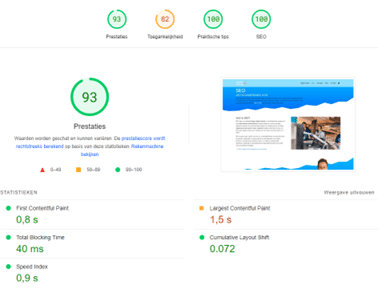
Admittedly, however clearly we explain them, technical SEO tips aren't always meant for beginners. So for fixing your technical SEO problems, rely on an experienced SEO agency or on a web builder that holds our SEO Label. They're guaranteed to build an SEO-proof website for you.
Is your website there to bring your audience to your business, or to market location-based products or services? Then dive into our guide to local SEO. The big advantage: competition is usually smaller and the traffic is hyper-relevant.
First and foremost, make sure your Google Business Profile (formerly known as Google My Business) is filled in perfectly. That gets you on the search results page under the ‘Businesses’ heading on a Google Map. A small effort that gets you a lot more visibility and traffic.
Then there's the bigger picture. Customers need to find you on as many platforms as possible. This is called Search Everywhere Optimization. Because these days our search behavior goes way beyond Google. We do our research on TikTok, Amazon, Trustpilot and so on. So open all the doors. Also apply GEO (Generative Engine Optimization), so AI engines pick up and cite your content. AIO (AI Optimization) takes care of your visibility in Google’s AI Overviews.

Nobody knows your business and your industry as well as you do. Your gut feeling will no doubt take you a long way in the right direction. Still, it's well worth taking a close look at what your competitors are up to and which keywords you should focus on. You'll find all of that in the Architect tool.
An SEO competitor analysis shows you how far others have come with their content and authority, and which content ranks in the search results right now. Keyword research tells you what your audience types into search engines. Three golden tips:
- Go for keywords that are relevant to your products or services.
- Stick to one keyword (including synonyms) per page.
- Connect keywords that belong together in content clusters.
A long-tail keyword consists of several words that belong together. An example makes the difference with a short-tail keyword clear right away:
- short-tail keyword: SEO tips
- long-tail keyword: the best SEO tips for beginners
About 70% of all searches consist of long-tail keywords. On top of that, there's a lot less competition for them, so your chances of ranking high are bigger. That's why we call this SEO strategy Sniper SEO. Long-tail keywords are hugely important and potentially very profitable. Long keywords are very specific: your user knows exactly what they want. So it's up to you to serve them targeted and relevant content.
One of the most important of our SEO tips. Google wants to help its users with quality content. If you offer that, Google puts you at the top, so more people get to enjoy your helpful content. So: don't write SEO copy to rank high in search engines, but to give answers that actually help your audience. That's how you “naturally” end up high in the search results.
A good SEO tip for writing helpful content is to keep search intent in mind. There are four types: informational, navigational, commercial and transactional. What is your audience really looking for, what answer do they want to their question? Anyone who googles ‘SEO tips’ is probably looking for information to get started on their own. That's why we share our knowledge in detail here and don't try to sell you our SEO book, for example (even though it's packed with practical SEO tips too, of course 😉).

Give your new page a URL that's as short as possible. That's more pleasant and clearer for visitors and search engines alike. In your webshop, for example, feel free to leave ‘/category/’ out of your product URLs. You make that structure clear with the right internal links.
Content beats length. The days when long texts automatically beat short copy are over. So say what you want to say and can say, without counting words. Above all, make sure your reader gets an answer to the question they typed into the search engine by the end.
In practice, though, we notice that texts under 250 words always struggle to rank high in the search results. Around 750 words is the average length of a ranking page. With long-form content of 1,500 words or more, you have all the room you need to inform readers and keep them on your page – as long as your text is relevant and interesting, of course.
So don't keep writing just to add words. Do dig deep into a topic, as long as you keep your reader hooked. We're heading toward 2,000 words here, but admit it: you're still reading, intrigued, right?
A clearly structured text reads smoothly and makes it easy to find specific answers. Structure has a big influence on user experience, and so it affects your SEO. So make sure you have a clear introduction, middle and conclusion.
Then split your copy into paragraphs that each cover one idea. White space adds calm and overview. Definitely add headings. Your text has one main heading (H1) and one or more subheadings (H2, H3 and H4; the rest rarely comes up in practice).
One of our most important SEO tips: use your keywords not too rarely and not too often in your text, and definitely in the important places. For those places, think of the following spots:
- at the start of your page title
- in your meta description
- at the start of your H1
- in a few subheadings, not necessarily all of them
- organically in your text
Some plugins use colors to show whether you should put your keyword in your text a bit more or a bit less often. We don't believe in that ourselves. Again: write for your audience, not for search engines. That way your keyword, the topic of your text, ends up in your copy organically. Don't overdo it: avoid that kind of keyword stuffing by using synonyms and long-tail variants.
Internal links are connections from one page of your website to another page on the same website. These clickable words are the tool for sending crawlers around and grouping content clusters. You place internal links on a relevant anchor text that relates to the page you're linking to.
- bad internal link: “Click here to read more about anchor texts.”
- good internal link: “There's a lot more to say about anchor texts.”
Breadcrumbs are internal links too: they have a positive effect on your SEO and so help you rank higher in Google.

Images matter too: they inform, entertain and convince readers. But for now, search engine crawlers don't have eyes. To still rank high in Google Images, give your images the right file name, title and description. Find all the tips in our guide to SEO for images.
What's on your page matters. But don't forget what's attached to it. The metadata, specifically your page title and meta description, is what search engines show in the search results. Based on this, your audience decides whether to click through or not. So keep the following in mind when you fill in your metadata:
- Your page title is 60 characters max, your meta description 120 to 160 characters.
- Make sure your page title has your keyword at the start, and that it comes back in your meta description, possibly together with a synonym.
- Use your page title to highlight USPs and your meta description to add CTAs.
Test your metadata with our SERP simulator and see what the gateway to your page will look like in Google's search results.
Internal links are an essential first step, link building is the important next one to reach the top spot in the search results. Link building gets you backlinks: links from an external website to yours. Ideally, they come from quality, trustworthy and relevant websites with lots of authority and expertise.
Link building might be the hardest pillar to give practical SEO tips for. First of all, again, create quality content that shows your own authority and expertise. Google bundles these signals under the term E-E-A-T (Experience, Expertise, Authoritativeness, Trustworthiness). That makes it more likely others will pick it up. Another method is digital PR. Backlinks from well-known media are very strong. You can also offer your content to others yourself.
This might be the most important of our SEO tips. The internet never stands still, and Google updates keep coming in the hope that the search engine shows ever better and more relevant results. The trick is to respond to those changes to keep ranking organically. Luckily, keeping your website up to date technically and content-wise already gets you a long way. What's more, the core has stayed the same for 20 years. Every update proves that delivering quality is the fastest route to the top of the search results.
Reaching the top spot in Google really isn't a given. You literally start from nothing and crawl up from position 50 to 20, but you have to wait until you reach the top 10 or even the top 3 before you see business results. These SEO tips help you work your way to the very top. Stuck somewhere anyway? Don't hesitate to contact us, and we'll gladly get you back on track.