
Domains and the Perfect Match for Your SEO
When you’re driving somewhere, you’d rather enter the address of your destination than the coordinates. The GPS will convert them for you. Besides, addresses and domain names are easier to remember than coordinates and IP addresses.
Domains are incredibly useful for your visitors. But you can benefit from them, too. In this guide, you’ll learn how domain names work and how they impact your SEO.
The Structure of a Domain Name
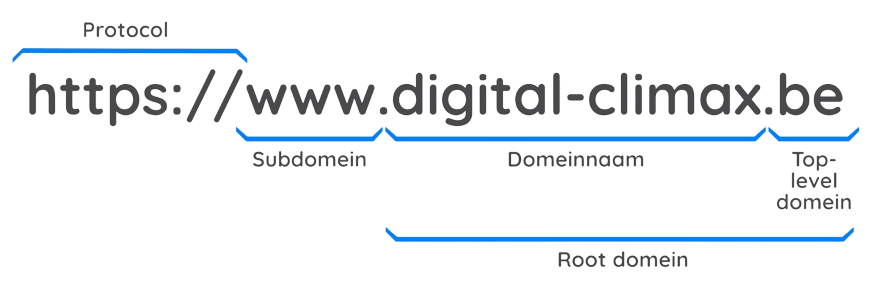
A domain name consists of several parts, separated by punctuation marks such as periods.
- Protocol: The way your domain or page is accessed. The “Hypertext Transfer Protocol” (HTTP or HTTPS), for example, ensures that you can view a web page. Browsers often add this automatically.
- Subdomain(s): A further branch of your domain that’s part of your website. www is a well-known example, but blogs, for instance, are sometimes set up separately—below, you’ll find out why we’re not fans of that, by the way…
- Domain Name: This is the actual domain name, such as your company name.
- Top-Level Domain (TLD): Also known as the extension of your domain name. For Belgian websites, this is often .be.
- Root domain: The unique combination of your domain name and the TLD. This is what you register and secure.
What about spaces and special characters in your domain name?
It’s best to avoid special characters in your domain name. For example, hyphens, underscores, and spaces are not allowed. It’s best to simply omit hyphens. How to handle spaces in your domain name is a matter of debate.
A space improves readability. That’s why we’re big fans of it. It’s best to replace it with a – (hyphen). However, a hyphen has neither a positive nor a negative impact on your SEO. So just do whatever feels right to you.
1) Default domain
90% of domains are standard domains. These are made up of your company name and clearly define your identity. A good example is digital-climax.be. Or the website of the local pigeon club: www.delustigeduif.cooom com com com… 😉
The benefits of standard domains:
- Your brand name is in the spotlight.
- They’re easy to remember.
2) Exact-match domain
An exact-match domain is a domain name that consists entirely of your keyword(s). Examples include loodgieterij.be or herentals-badkamer-toilet-herstellen.be. This makes it an interesting option if your primary traffic comes from SEO.
Even more benefits of exact-match domains:
- It’s immediately clear what your website is about, so you can be sure that it’s relevant to your visitors.
- Exact-match domains typically have a higher click-through rate (a greater number of clicks per ad impression).
- They’re also easy to remember.
Especially in Google’s early days, an exact-match domain provided a huge SEO advantage. They performed so well, in fact, that users barely had to work on their website’s design and content.
Today, we therefore associate exact-match domains with low quality. Furthermore, the SEO benefit decreases with every Google update.
In most cases, we therefore advise against choosing an exact-match domain. This is definitely a no-go, especially if you want to raise awareness of your brand.
Case study
We were once offered the chance to buy seo.be. That’s an exact-match domain for the keyword “SEO.” However, the asking price for such domain names is often absurdly high—especially when you weigh it against the actual benefit.
We therefore prefer to invest that amount in our own branding and improvements to our website. This is advice we follow ourselves—and that we therefore also give to our customers.
3) Partial domain match
A partial-match domain is a compromise that often works better. It contains both your keyword and your company name. That’s why it’s called a partial match.
Very often, companies already do this automatically in their names. Consider, for example, “elektro-companyname.be” or “companyname-woodprocessing.be.”
Although it’s less effective for SEO than an exact match, this is the perfect solution for us.
The big advantage:
- The combined strengths of the standard domain’s branding and the exact-match domain’s online visibility.
Take advantage of these quick tips for choosing a strong domain name. The rule of thumb: keep SEO in mind, but don’t get too caught up in it.
- Make sure your domain name is easy to remember.
- Make sure it’s legible and pronounceable.
- Make sure it’s easy to write.
- Avoid using numbers.
- The shorter, the better.
- Make sure your business and what you offer are easily recognizable.
- If possible, include a keyword in your domain name, but don’t focus too much on this.
A subdomain is a branch of your main domain. Here are a few examples:
- testenvironment.domain.be
- blog.domain.nl
- jobs.domain.com
“Test environment,” “blog,” and “jobs” are your subdomains in this example. They are part of your domain but are still completely separate. Companies often choose to host their blog separately, for example. This is usually done for technical reasons.
However, it’s less than ideal for SEO. Google treats each subdomain as a separate entity with its own authority, content, and technical aspects. This means you have to start from scratch every time when building your authority.
So make sure you incorporate everything into a single website. It may require more work now, but it will save you a lot of headaches down the road.
For the same reason, it’s better to use subfolders on your website than subdomains. Subfolders are the building blocks of your website. Search engines can easily process them. So don’t use wood.domainname.be; instead, use domainname.be/wood/type. You can then access the /type path from the /wood subfolder.
There are exceptions where a separate subdomain is indeed useful. However, in most scenarios, these are very limited.
“www” is a subdomain
Today, you have the choice of whether or not to include “www” with your domain name. Keep in mind, though, that “www” is a subdomain.
Whether or not to use “www” often causes indexing errors on websites. You should also avoid internal links or backlinks that sometimes point to “www” and other times to the alternative version.
Did You Know?
The term “World Wide Web” was coined in 1990 by the English software engineer Tim Berners-Lee. The name gained popularity despite protests from his Belgian project manager, Robert Cailliau, who objected to the English abbreviation “double you double you double you,” which is longer than the term itself.

Depending on your niche, it may take more effort, time, and money to succeed with your chosen TLD. That’s reason enough to give it some thought before you register your domain. Switching after the fact means starting completely from scratch. So never change your domain name on a whim.
.be vs .com—which is better for SEO?
Google favors local websites. With a .be domain, you’ll generally rank higher in Belgium, while a .com domain works better internationally. .com stands for “commercial,” so many online stores are more likely to choose a .com domain than regular websites. Be sure to carefully consider your long-term goals.
- Are you focused on Belgium—and will you continue to be? Then a .be domain is perfect for you.
- Do you have an online store? If so, choose a .be or .com domain.
- Do you want to expand internationally (in the long run)? A .com domain is the way to go.
Register both your .be and .com domains right away. That way, you can be sure no one will snatch up your brand or domain name. Yes, we’ve seen that happen many times. There are even companies that do nothing else…
A separate TLD for each country?
Suppose you want to attract customers in Belgium, the Netherlands, or Italy. Would you choose a single .com domain or a local domain for each country—namely .be, .nl, or .it?
A local domain often works better, though that’s no guarantee. Having a separate website for each country does require a lot more technical expertise and budget. Furthermore, Google treats each domain as a fresh start. This means you’ll need to invest in each domain name separately. It’s best to set aside an extra budget not only for your SEO but also for setup and maintenance.
Internationally, a well-translated .com domain name often works best. This also allows you to consolidate all your authority on a single domain, which is particularly beneficial when focusing on linkbuilding.
Do you have a multilingual website, or do you want to succeed in multiple countries or languages? If so, you should use a .com domain.
Registering a solid domain name is always a good idea. Once you own it, you can do all sorts of things with it. You might even be able to resell it in the future.
For your SEO, an additional domain name only adds value if you redirect traffic to it or host a separate website on it. That way, it helps you rank higher in search results. Simply buying it and doing nothing else with it serves little purpose in terms of SEO.
A redirect or a separate website?
You have that extra domain name—now what? One option is to set up a redirect. When a visitor types in the exact-match domain, they’ll simply be directed to your main domain.
The advantage: thanks to your additional domain name, search engines associate you more closely with your keyword. However, registering as many domains as possible and having them redirect to your website doesn’t make much sense. After all, the effort isn’t worth the result. Moreover, this offers little added value in terms of SEO.
Another idea is to use your additional domain as an exact-match domain. You can set up a separate website on it that focuses solely on SEO. It’s up to you whether you link your “real brand” to it or treat the additional website as a separate entity.
Each TLD is also treated as a separate entity. To secure your domain name with both .be and .com, you must register both and pay for them.
A domain that has never been registered before starts from scratch. You start with a clean slate and have to build up all your authority on your own. That often requires more work.
The other option is to acquire an existing domain name that is currently registered or was registered at some point. Search engines will already be familiar with it.
But in that case, you’re also taking on its history. That can include some unpleasant surprises, such as black-hat SEO techniques. So taking over a domain name isn’t without risks.
Tip
Always have this reviewed by an SEO agency.
Research the history of your domain
Are you interested in the acquisition of a domain and its history? To find out, answer these questions:
- What website used to be on this domain?
- What was that website about?
- Were there already any backlinks to the site?
Tip
You can identify important factors such as keywords for which the domain used to rank, backlinks, and anchor text using an online tool like Ahrefs.
How important is a domain’s age?
“The longer your domain has been registered, the better the SEO results,” some experts in the field believe. However, they are confusing cause and effect.
A domain that has been around longer usually has a longer history and, therefore, more content, more backlinks, and more of everything. It makes sense that such websites rank higher.
However, you don’t get any benefit simply because your domain has been registered for a longer period of time. Not even if you renew it immediately for the next five years. It just makes it less likely that you’ll forget to renew it (though your hosting provider often handles that automatically).
Google does take into account the history associated with your website. Those backlinks, internal links, and so on are reflected in your website’s indexing. Your domain’s history is therefore more important than its age.
Sometimes you need to change your domain name. Your company is undergoing a rebranding, you’re bringing on a new partner, or you’ve decided to switch from .be to .com after all… So what’s the best approach for your SEO?
We refer to a change in domain name as a domain migration. Very often, this goes hand in hand with a new website, also known as a website migration.
Check out our guide to SEO migrations. In it, we explain step by step how to get started and what the pitfalls are.
Change as little as possible at one time. Choose either a domain migration OR a website migration. Doing both at the same time is much more difficult.
Domain authority is a metric used to measure your website’s authority. Think of it as your online reputation: how often do other websites link to yours, and what do they say about it?
External tools like Ahrefs and MOZ coined the term “domain authority.” Google itself doesn’t use it, at least not in that exact calculation. So don’t optimize solely for this metric; instead, use it for its intended purpose: to gauge how much authority your domain has.
Although SEO is important, it isn’t the deciding factor for your domain. We recommend that you carefully consider your TLD. After all, it could come back to haunt you in the long run. Today, your startup may only sell in Belgium, but in five years, it might be selling in the U.S. In that case, that .be domain will suddenly be much less effective at attracting potential customers. Read more specific tips on SEO for startups here.
The value of an exact-match domain decreases with every Google update. Because of their history, existing ones are often still found. But from an SEO perspective, a new exact-match domain has to work just as hard as a regular or partial-match domain.
Are you interested in acquiring a domain? If so, be sure to thoroughly analyze its history.
Does your domain name affect SEO?
Yes, your domain name does affect your SEO results. Depending on your specific question regarding a domain name, the impact can be greater or lesser. In this blog post, we’ll take a closer look at each scenario.
What should you consider when choosing a domain for SEO?
In a nutshell, when it comes to SEO, you should pay attention to the following factors regarding your domain name: TLD, whether it’s an exact match or not, the domain’s history, subdomains, and additional domains.
Table of Contents: Domain Guide
- What is a domain name?
- Types of Domains
- 7 Tips for Choosing Your Domain Name
- What is a subdomain?
- Which TLD (Top-Level Domain) should I choose?
- Do I need to register additional domains?
- Should you register a new domain or take over an existing one?
- Changing domains—what now?
- What is domain authority?
- Which domain should I choose for SEO?
- FAQ: Domains