
Competitor analysis
An SEO competitor analysis looks into
- who your competitors are if you want to rank higher in search engines
- how your competitors rank today
- how your competitors got to their current position
On top of that, a competitor analysis teaches you which parameters Google finds important in your niche.
An example: if every website in the top 10 has lots of backlinks, you most likely need backlinks too. That's how a good competitor analysis quickly helps you set the focus of your SEO strategy.
A competitor analysis combined with keyword research gives you a lot of information. That's why we start every SEO project with those 2 analyses ourselves.
Don't confuse the SEO competitor analysis with the classic competitor analysis, where you compare your product or service with your competitors' on price, quality … The SEO competitor analysis focuses only on ranking in Google and other search engines. So the outcome isn't the same: different names show up in each analysis.
Of course, one doesn't rule out the other. On the contrary, they reinforce each other. To determine your place in the market, know what it takes to get where you want to be and find out who your competitors are, you'd better take both studies to heart.
Every beginning is hard, but nothing is impossible. We go through the actions you can take and the tools you need for them, step by step.
SEO tools for a competitor analysis
Every competitor analysis stands or falls with how thoughtfully you use your SEO tools. You need them to learn from your competitors' SEO moves. Without a good SEO tool, there's no point in starting. But hey: a fool with his tool is still a fool. So common sense remains a must, and experience is a plus.
Our favorite for keeping SEO competitor analyses on track is Ahrefs.
You still can't do without Excel
Besides Ahrefs, we still gladly use Excel. That's where we bring all our data and findings together. We collect everything in one detailed overview that we can come back to again and again. And based on that overview, we make the final SEO decisions.
Identify your competitors
To rank (higher) in Google, you need to know your competitors. There are several ways to find them:
- Enter your main keywords and see who ranks for them.
- Use what you already know: who are your biggest competitors? Make a distinction between online and offline competitors.
- Offline competitors are, for example, companies you often run into with prospects, where your prospects probably asked for a quote too. Or companies in your area.
- You run into online competitors all the time in Google, social media, email …
- Type your company name into Google: at the bottom of your ‘Google My Business’ listing, you'll see companies that Google associates with yours.
- Not always the best data, but sometimes a good source of inspiration.
This way you can usually name a few competitors pretty quickly. Online competitors are often a bit harder to identify. But once you have a basis, you can get to work.
An SEO competitor analysis isn't interesting for everyone. For example, it's no substitute for your market research or classic competitor analysis. And if you're just starting out, the research might take too big a bite out of your budget.
But have you reached the point where you really want to get going with SEO? Then an SEO competitor analysis is a must. Because without a competitor analysis, you have no idea who you're up against, and you don't know your options for beating your competitors in the SERP. And, just as important, you don't know which keywords are still within reach today.
There's no fixed procedure for a competitor analysis. You keep discovering new things and build on them. So see the competitor analysis as a repetitive process of continuous learning and improving.
Here are a few pointers for using the competitor analysis in your search engine optimization.
Your competitor's link building strategy
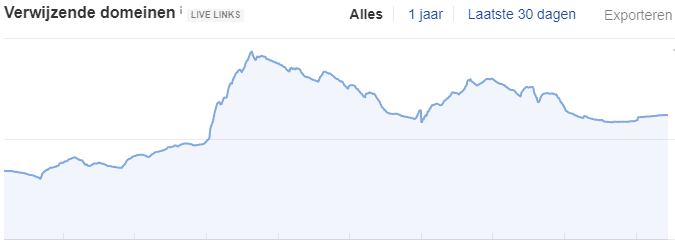
With common SEO tools you can check which link building strategy your competitor uses. Has the company grown slowly and organically over the years? Or did it suddenly shoot up (and so invest heavily)?
The speed, total number and frequency of new backlinks tell you how much your competitor invests in link building. The way they build links (think of the quality of the backlinks) becomes clear too.
Analyzing your competitor's backlink profile
Besides the number of backlinks and the speed at which your competitor collected them, the profile of all those links gives you other important information.
We can't repeat this advice enough: a few quality links get you more than thousands of (near-)spam links. So always choose quality over quantity.
Also look at the ratios and the quality of your competitor's links. Do they have lots of low-quality links? Then that can be a signal for you to grab a few of those too. Huh? Didn't we just say quality beats quantity? Right, and we stand by that. But… as a beginner in SEO, you're behind your competitors. You're in the red, so your first concern is to catch up. Those backlinks can help you do that. Level with them? Then it's time to overtake them.
Watch out!
This is sensitive stuff. In general, we recommend sticking to quality. Especially if you're just starting with SEO, you'd better stay on the straight and narrow. It's easy to get lost in the maze of link building. And finding your way back to repair your site is many times harder than simply doing good work.
Keywords
When you collect your focus keywords, take a peek over your competitors' shoulders too. Do keep it realistic, though: you won't just overtake a website like Wikipedia. It has proven for years that it offers quality information, and has built up a huge amount of authority as a result.
It all depends on your ambitions, of course. Say your ultimate goal is to rank number 1 for SEO: then you'll have to beat Wikipedia someday. That's your long-term vision. To begin with, the first page of Google is a fine goal. Then the top 5, the top 3 and finally number 1.
Draw up a realistic and clear plan for yourself. For the short, medium and long term. Set your goals for each period, so you can work toward them step by step.
Pick your battles
If there's one thing to remember from all this, it's this. Not every keyword is interesting: you have to make choices. So study your own site and situation carefully before you start an SEO competitor analysis. That way you can put your data next to your competitors'. And based on that, you make the calls and set your priorities.
Further reading: which keywords does my competitor use
Keyword Difficulty, a good yardstick
So, pick your battles. How do you do that? Here too, we have a soft spot for Ahrefs. The tool helps you make the right choices by showing the Keyword Difficulty (KD) for every keyword. That metric tells you how hard it is to rank for that keyword. It's a great starting point to decide which keywords to go for. It's not an absolute value – tools give estimates and calculations. That's why SEO takes feel and experience.
Note: KD is mainly based on backlinks.
SERP layout for keywords
What a lot of people forget is to look not only at who, but also at what exactly ranks right now. With the SEO competitor analysis you mainly look at who ranks in Google today.
We strongly recommend looking at the what side of the story too.
What kind of websites rank at the moment? Informational blogs, product pages, webshop category pages, photos, news articles… Taking that information into account tells you which type of content you need to win your spot in the top 10.
There's no point in publishing blog articles if only category pages (e-commerce) rank.
Further reading: E-commerce SEO for webshops
For most of the procedures we've covered so far, you need an SEO tool. The competitor analysis technique below requires some experience, and it's important to add the right nuances.
Content gap analysis
In a content gap analysis, you look for search terms other websites rank for and yours doesn't yet. An extremely valuable element, and you'd do well to look at each search term separately. After all, not every competitor offers exactly the same products or services, so not all the results it turns up are equally relevant.
So put together a solid filter to tell them apart, and don't be tempted by big search volumes. Relevance matters more than volume (remember: quality beats quantity).

The term competitor analysis sounds pretty vague, and often it is. Still, an SEO competitor analysis gives you a big advantage: you get a better view of your niche and of what you need to rank higher in Google. Just as keyword research shows you which keywords to target, your competitor analysis tells you what to focus on, and above all: what not to.
The competitor analysis helps you set your priorities. You know where to start and how to keep building, step by step, a website that ranks high in Google.
An SEO competitor analysis also helps you find new keywords, map backlinks and avoid pitfalls. Together, all of that makes decisions easier.
- Relies heavily on tools
- Is very technical
- No general rule to follow: it's a repetitive process. Step by step you learn more and gather more info to expand your SEO.
- Often not the first thing you start with.
- Overlaps here and there with keyword research
With the tips above, you have everything you need to run an SEO competitor analysis for your website. Lacking the experience, or don't have the time to give it a go? Get in touch, we're happy to help.
Table of contents: SEO competitor analysis
- What is a competitor analysis
- What you need for an SEO competitor analysis
- How to start a competitor analysis
- When to run an SEO competitor analysis
- Components of a competitor analysis
- Advanced competitor analysis techniques
- The value of an SEO competitor analysis
- How to use a competitor analysis for SEO
- Competitor analysis: conclusion