
SEO vs SEA, what’s the difference?
Similarities & differences between SEO and SEA
SEO and SEA are terms that everyone has heard before. Digital Climax specializes in SEO. Both techniques have pros and cons. The applications and timing of use also differ between SEO and SEA.
Discover how and what you can do to rank higher in Google, because that’s what it’s all about in the end.

What is SEO?
SEO stands for Search Engine Optimisation. On our website, you’ll discover the ins and outs of this process. Here, we mainly zoom in on when to choose SEO and when not to.
What is SEA?
SEA stands for Search Engine Advertising. We don’t do this ourselves. However, we’re happy to put you in touch with partners who can help you with this. Because yes, SEO and SEA go hand in hand. We sometimes call them brother and sister. They can’t live without each other, but sometimes they can’t live with each other either. More on that below.
What is PPC (Pay Per Click)?
SEA works according to the PPC principle. With this, you pay per click to your website. PPC literally stands for Pay Per Click. So you can have 1,000 impressions on your ads, but as long as no one actually clicks on your ad, you pay nothing. A very advantageous model. On social media, you pay for impressions, regardless of the number of clicks to your site.
The terms PPC and SEA are often used interchangeably because search engines are almost the only ones that apply this model.
What is SEM?
SEM stands for Search Engine Marketing. That is the umbrella term that includes both SEO and SEA.
What are the differences between SEO and SEA?
Even though SEO and SEA are brother and sister, they differ in many ways. We’ve listed the differences between the 2 terms below.
Short vs Long term
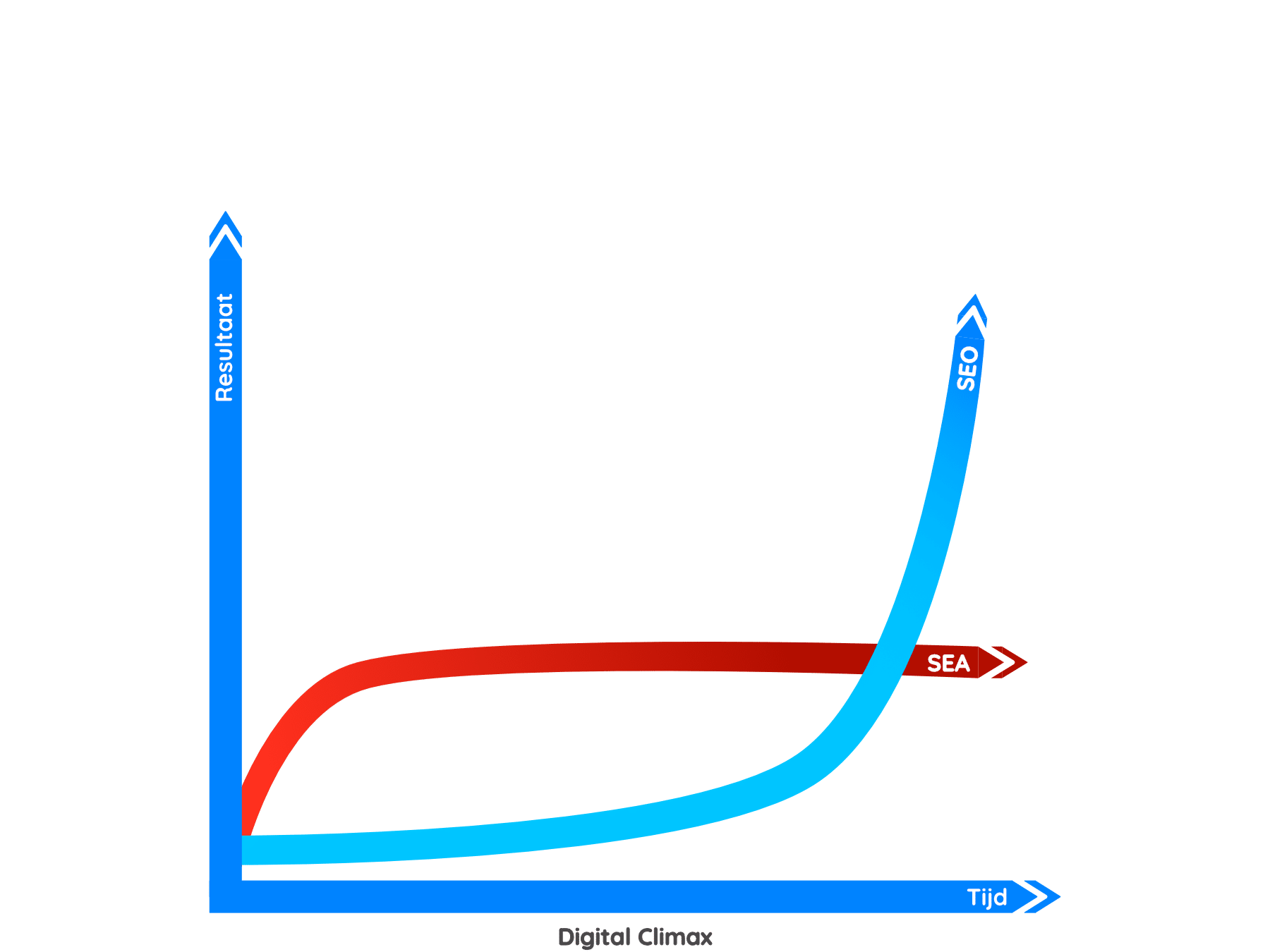
Since you pay search engines with SEA, you’re at the top immediately. That makes SEA a short-term strategy. Also, because your budget is set, you get results quickly, but those results level off fairly fast. In the long run, there isn’t much growth without increasing your budget.
SEO, on the other hand, works in the long term. You get to work with technology, content, and authority—3 pillars you optimize. That means you won’t be at the top overnight. You only see results once the search engine rewards your efforts.
“Free” vs Paid
SEO results are often seen as free. Basically, it’s about organic traffic versus paid traffic. With SEA, it’s clear: you pay per click. The costs of getting traffic are obvious.
With SEO, it’s not clear what costs you need to incur to rank at the top. You’re always investing, either in time or in hard cash.
Time investment
With both channels, you invest time on a regular basis. You can adjust and optimize things monthly, weekly, or even daily. The time investment in SEO is quite a bit higher than in SEA.
With SEO, it really is an investment; with SEA, we see it more as a cost. Every euro you invest in SEO stays with you for years to come. Every euro that goes to SEA better yield something, as it disappears into the search engines’ pockets.
Position in Google
The search engines’ business model rests on SEA. So, ads are always above the organic results. Yet 94% of people scroll directly to the organic results.
We all know by now that you can pay to be at the top. To rank organically, you have to improve yourself. Your website needs to be on point, your content needs to be engaging and helpful, and you need to work on your online image (authority).
For that reason, we still have more trust in organic results.
Targeting
In your ads, you can choose to only show them to people with a certain profile, who live nearby, and based on relevance. With SEO, you focus on specific keywords. Thanks to keyword research, you know which ones exist and what people are searching for.
It’s not possible to specify your target audience in SEO—at least not with settings and buttons. By choosing the right keywords with the right search intent, you ensure relevant traffic.
How does SEA work?
SEA works based on the PPC principle, which you already know by now. You create an account with Google, link your credit card, and set up your ads. It’s that simple at its core. Your ads start running and you pay for every click to your website.
Setting up your ads correctly and adjusting them later—what do you do if there’s no return?—is an art in itself. That’s exactly why we chose to specialize in one of the two. For us, that became SEO.
We always recommend working with experts on every channel. That way, you get the most out of your budget. Just make sure all those experts aren’t working in isolation and get them to collaborate.

SEO supports SEA and vice versa
Collaboration—that says it all. SEO and SEA are separate specializations, but one can learn from the other and vice versa. With SEA, you’re at the top immediately. You learn which keywords bring in customers and, more importantly, which ones don’t. You gather data at a fast pace.
With that data in hand, you can get to work with SEO. That way, you know which keywords to focus on—the ones that actually make money.
Tip:
We always recommend running SEO and SEA side by side. However, we keep in mind the goal of being able to turn off that SEA campaign as soon as SEO can take over. That saves you a lot of advertising budget (though in some niches, this isn’t possible).
By optimizing your website for search engines, you don’t just rank higher organically in Google. Your SEA results benefit too. Your cost per click is partly related to how relevant your page is for that keyword. By investing in SEO, your SEA campaigns become cheaper.
What are the similarities between SEO and SEA?
Besides differences, there are also many similarities between SEO and SEA. They both play out in search engines—that’s pretty obvious—but there are also things that yield results for both SEO and SEA.
Conversion tracking
For both channels, it’s important to be able to measure your conversions properly. Only then do you know if your efforts are paying off and exactly what they’re yielding. Measure how many forms are filled out, how often you’re emailed, and how many phone calls you’ve received.
With good conversion tracking, you assign leads to campaigns and learn step-by-step what works and what doesn’t. That way, you can scale what works and turn off what’s just costing money.
Continuous process
You read it above already. You learn step-by-step. No one has a crystal ball. So you have to test, adjust, and adapt things. It’s best to do that based on data. By testing new things, you’ll move forward and get better results with the same budget.
Using SEO and SEA together, how do you do that in practice?
This is our process for setting up SEO and SEA and getting the most out of both channels.
1) SEO & SEA startup
Start at the beginning. Which keywords are you going to use (yes, there’s a difference between your keywords for SEO and SEA)? What’s your budget? How are we going to capture people?…
In this phase, you map out all the variables, bring them together, and set up a strategy.
2) Tools & platforms
With all that data, you know how to set up your ads, what content you’re going to write, and which backlinks are needed. Set up your ad account, submit your website to Google, choose your SEO tools, and set them up.
3) SEM-Loop
Start. That basically says it all. This step is so diverse. Every company needs a different approach. There’s no standard formula that works for everyone. By starting, you also start learning.
The faster you learn, the faster you can scale, adjust, and generate revenue. Neither SEO nor SEA will bring in new customers overnight. You have to learn and continuously adjust.
We often set up an SEA campaign to learn faster. That way, we can use the significant time we put into SEO more efficiently.