
Link building: what are backlinks and how do you get them?
What are backlinks? And how relevant is link building in 2026?
Want to rank in Google? Then your website has to meet three basic conditions. First, your website has to be technically sound: fast hosting, a responsive design, a logical structure. The second condition is about content. It has to give your visitors added value. After all, that's what they came for. And the third condition is about authority, which you build with links, among other things.
The more backlinks, the more authority you have. But what exactly are backlinks? How do you get them to your site? And what does the future of backlinks look like? You'll find all the answers, and more, in this article.

Link building guide available to everyone
Our link building guide has gone down well. We're happy to give you plenty of practical tips for collecting better backlinks. After so many requests, the guide is now on the website. Enjoy the read!

A backlink is a link on another website that points to your website. With it, the other website signals that your website is interesting.
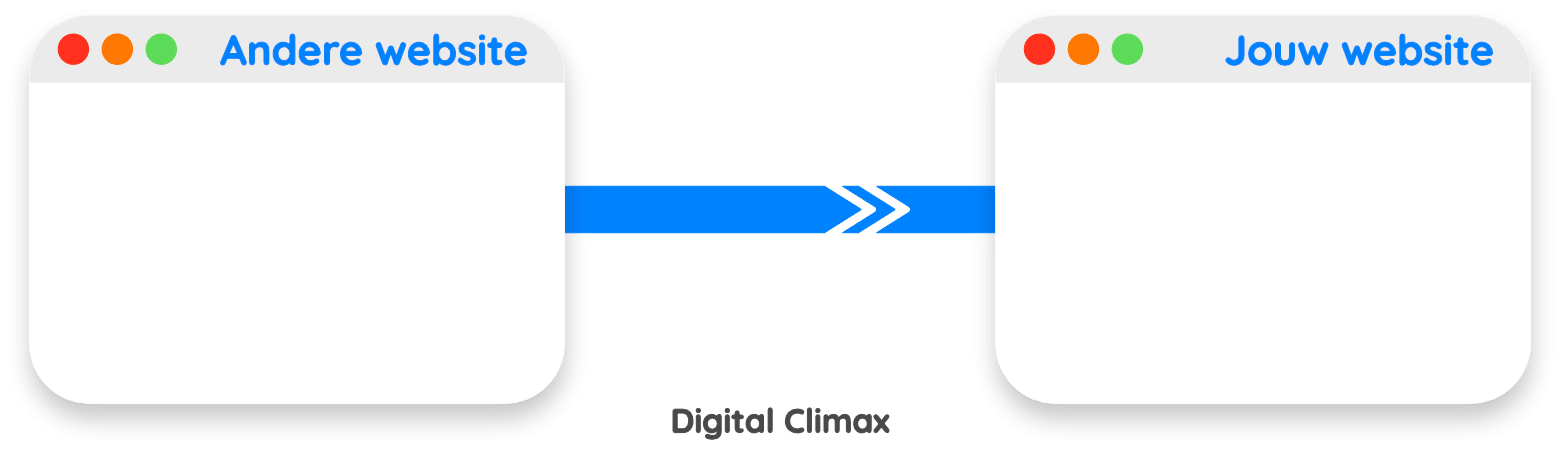
It's generally assumed that backlinks have a significant impact on your SEO. Is that still the case today? Originally, Google leaned heavily on its PageRank algorithm. But Google keeps learning and updates its algorithms regularly. Marketers exploit backlinks, and the search engines respond. Because they always think in the interest of their customer. That's their reason for existing: serving searchers as well as possible.
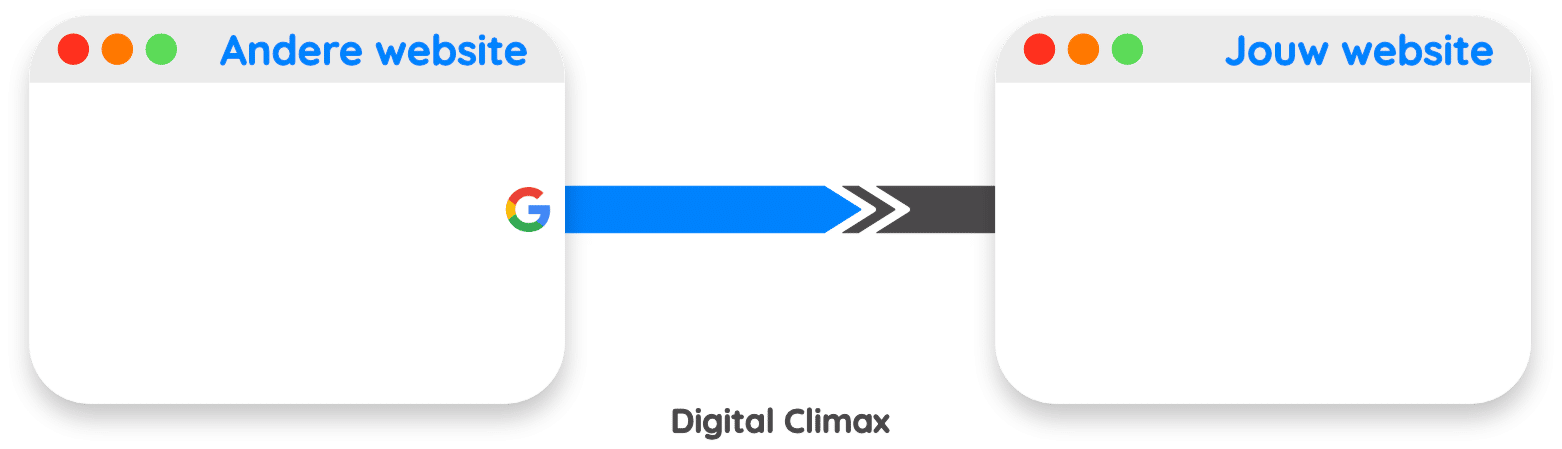
Not all backlinks are equal. Some add value to your site, read: they increase your authority. And some backlinks achieve pretty much the opposite.
What is a good backlink?
A good backlink is a link that comes from a site that:
- is relevant to your site (= same topic)
- is high quality (= no SPAM)
- has your keyword in the anchor text
Make sure your site is filled with quality content. Is that not the case? Then you can collect all the backlinks you want: to Google, they're worth little or nothing.
Do you follow these rules of thumb? Then you're always safe! No stress about penalties.
What is a bad backlink?
If good backlinks exist, so do bad ones. When does Google rate links as bad? When you get them in one of the following ways:
- you buy links
- you swap links one-on-one
Tip: Swap links using the ABC method. How does that work? Website A links to website B, website B to website C, and website C to website A.
With a standard link exchange (A links to B and vice versa), your link loses its value. With the ABC method that's not the case, because search engines are slower to detect it.

- you guest blog on a large scale with too many keywords in the anchor text. Result: the content doesn't read well.
- you use automated programs that create links to your site
That said, the methods above aren't always violations. So always look at each link in its context.
Ask yourself: would I want this link if Google didn't exist?
No doubt you'd appreciate a link from an authoritative website (say, the national newspaper or a blog with lots of followers) even without the backlink value. But a link on some hidden-away link directory page, even one with a DR of 60: are you just as excited about that? I bet you're not.
Need to decide whether or not to accept a backlink? Then forget about the search engines for a moment and judge objectively whether that backlink adds value for you. Is the answer yes? Go for it. Is the answer no? Don't give it another thought and don't accept it.
Removing bad backlinks
Do you have bad backlinks like these and want to get rid of them? Find out how to do it efficiently in the article: How to remove bad backlinks.
So there are good and bad backlinks. Backlinks also differ in function: what's the purpose of certain backlinks? And what do you want to achieve with them?
DoFollow link
A DoFollow link is a standard link. And you use it as intended: to point to another website. Google follows the link and looks at the content at the destination. Every link that doesn't have a NoFollow attribute is automatically a DoFollow link.

A DoFollow link has a direct impact on your ranking. The authority of a website is passed on (link juice), and search engines pick that up as a signal.
NoFollow link
To your visitors, a NoFollow link looks exactly the same as a DoFollow link. The difference is on the back end, or back office (CMS), of your website. For a NoFollow link, you add a small piece of code: rel=”nofollow”.
So a NoFollow link looks like this:
<a href=”www.link-to-your-website.be” rel=”nofollow”>Anchor text</a>
And that makes a world of difference. A NoFollow link passes on no authority. Why does that matter? NoFollow links counter comment spam (posting your website as a comment on every forum). NoFollow links also help you avoid penalties.
Typical NoFollow links come from:
- blog comments
- social media
- forums
- articles
- paid content
So are NoFollow links completely pointless?
No, absolutely not! NoFollow links keep your backlink profile in balance. And they help you build brand awareness. Even without Google's algorithm, a link on certain websites would still be valuable. For example, on pages with lots of visitors who click through to your site.
Sponsored links
Just like NoFollow links, you mark sponsored links with an extra attribute: rel=”sponsored”. Sponsored links indicate that the link was placed as a promotion or an ad.
UGC (= User Generated Content)
UGC links mainly appear on websites where visitors can post content. Think forums or blog comments.
UGC and sponsored links are relatively new. They were only introduced in September 2019. The nofollow attribute has been around since 2005.
Link building means actively looking for new backlinks that lead to your website.
How do I get more backlinks?
Backlinks don't come by themselves. Nobody links to your homepage just because it looks nice.
Still, there are ways to collect relevant backlinks. Enter link building:
- Start guest blogging
- Write quality content
- Send targeted emails to companies or organizations with relevant websites, or with pages where your content adds value. Check out our case study.
- …
Buying links is also an option. But read on to understand why we advise against it (in most cases).
How do I get free backlinks?
Your chances of getting free backlinks are highest when your link proposal is hyper-relevant. In other words: when you have content to offer that brings added value to the other site. The hardest niches are the ones where people know what a link is worth. And that's exactly why it's still worth a try, especially if you offer relevant, high-quality content.
Can I buy backlinks?
Backlinks are for sale in lots of places. But watch out: you're in a gray area. Whatever you do, don't buy links in bulk on link directories and shady websites. They won't have a positive effect on your website. On the contrary: they often even earn you a penalty.
And what if I pay a blogger to link to my site?
Search engines see that as less bad than buying backlinks like the ones above. Still, it's a purchase, tied to the input and opinion of the guest blogger. And is that content relevant or valuable for your site? (see below: 9 proven link building techniques – no. 2, guest blogging)
How much does link building cost?
The value of a backlink depends heavily on the authority of the website. A good backlink easily costs you 80 euros. And that can quickly go up to 300 or even 500 euros and more.
How many backlinks do you need?
The number of backlinks you need to rank higher in Google depends on your market, in other words, your competition. To calculate keyword difficulty, tools like Ahrefs, Moz and Ubersuggest make estimates based on the number of backlinks. You usually get a score out of 100. Is the keyword difficulty high? Then you know the number of backlinks is high. And that you'll need a lot of them to make a difference.
Don't get fooled! Not every backlink adds value. Only quality links really move you forward. And watch out: the effect disappears just as fast when the content of your page isn't (or is no longer) relevant.
What are internal links?
Internal links are links on your own website that point to another page on your site. They're vital for your website's ranking. Google uses internal links to discover the different pages on your site.
Traditionally, most links point to the homepage. A common rule of thumb: point your internal links to your most important pages as much as possible. And that's not always your homepage.
The big advantage of internal links, of course, is that you control them completely. You add them wherever you want, you choose the anchor text, and you decide the priority of your pages. Just don't overdo it. A text stuffed with links is unreadable for your visitors and confuses search engines. And you want to avoid that at all times.
1) Quality content
Quality content always beats any link building strategy. Because what do Google and other search engines want? To help visitors as well as possible. And you do that with well-thought-out, relevant content. Feel free to go into detail and cover every aspect of a topic. With this guide, you can get started with link building right away.
If you give it some proper thought, or speedstorm with a colleague, you'll often be surprised how much interesting stuff you have to say about a topic. Also write down the questions customers ask you. That's what they're looking for answers to, and you give them those answers by writing about it. And keep in mind that things that are obvious to you aren't nearly as obvious to your customers, followers or visitors.
Promote your content enough through:
- social media
- PR websites such as:
- email marketing

2) Guest blogging
Guest blogging works for two reasons:
- On a good blog, you don't just build new links: you also build authority within the blog's network.
- Blog owners are often happy with your help.
Of course, some of them know very well that it benefits you too. So don't be surprised if you have to pay to publish an article. (See also Buying backlinks above)

3) Broken link building
One of the most efficient and easiest ways to collect links is broken link building. Read all about broken links in our SEO guide.
In essence, it comes down to this: look for links (relevant to you) that point to websites that no longer exist. The link is dead (broken).
Let the owner of the link know that the site no longer exists; that way, you're helping them out. And right away, suggest an alternative link that points to your website. That way, your effort is rewarded with an extra link.

4) Outreach campaigns
You can also focus on actively promoting your content. You can feel it coming: this tactic starts from quality content. Write to potential linkers and convince them of the added value of your content.
How do you find those future linkers?
Write a good email saying you'd like a link to your site or page. Explain what you do and what the benefit is for your future linker. Really put some work into it, including your email's subject line.
Sending emails is a time-consuming job. Luckily, there are tools like Pitchbox and Buzzstream to help you. And they're also good at following up on those emails. You can put them on semi-automatic pilot to scan potential linkers and collect contact details. You then feed those into an automatic follow-up. A kind of loop that, after a week, sends a follow-up email asking “Have you read our article yet?” That way, you invest in the setup once and reap the rewards several times afterwards.

5) Sponsorship link building
A technique that's often overlooked but does affect your local SEO? Sponsoring local events. Are you sponsoring the scouts' spaghetti night? The local brass band's concert? The quiz night of the soccer club in your town? Then make it a condition that they place a link to your website. For example, a link behind your logo.
This technique has a positive effect on your local SEO. Do websites from your area link to your website? Then Google picks that up and can better judge which region you're in. The result? When people nearby search for your services, your website will soon rank higher than your competitors'.

6) Buying links – paying for links
We already said it: paying for links really puts you on thin ice. Stay away from pages with hundreds of links and websites that exist purely to publish articles stuffed with links!

Remember
Is it too easy to buy a link? Then it'll do you more harm than good.
Paying for links is not the same as buying links. Do you hire a blogger, for example, or do some guest blogging yourself? Then website owners or bloggers will sometimes make demands: they ask for money or products from your range. They know the value of such a link all too well. So you have to ask yourself: what do I get out of it (WIIFM: what's in it for me)? Is it worth that amount to me?

7) Infographic link building
Infographics, especially ones that explain a difficult topic in a simple way, have a strong appeal. They make clear at a glance what you mean. And they invite your visitors to share them. That makes infographics a form of quality content that attracts new links, with the focus on shareability. Always ask people to credit you as the source when they share your image. That way, you get links to your site for which you barely have to lift a finger.
Tip: Put your logo or website on the infographic. If someone shares it without crediting you as the source, readers can still see where the infographic comes from.

8) Brand name
Rumor has it that… in the future, Google will detect mentions of your company or brand even without a link attached. Today, that's definitely not the case yet. Google needs links to put its crawlers on the right path.
We certainly don't expect links to disappear any time soon. Why not? Mentioning a company without a link isn't user-friendly for your visitors. That goes against the still-growing focus on user experience and usability. And what do search engines want? To serve users as well as possible and show them the way.
Still, you often see companies mentioned without a link. A golden opportunity for you! Especially if you already have some brand awareness. Search the internet for every place your company name appears. How? Type intext:yourbrandname into your search engine, and all websites or pages that mention your company name will show up. It also works if you type your company name between double quotes: “yourcompanyname”.
Is there already a link? Great! No link? Contact the owner of the website and ask them to add a link to your site.

9) Niche terms
Niche markets and industries each have their own specific terms. Jargon, difficult words that not everyone understands. Still, it's better not to overwhelm your visitors with them. Think of the beginners in your market.
Do you give them a good, understandable explanation (= quality content)? Then you're helping them out. And do they want to publish something about that topic themselves, on their blog or website? Then they'll quickly link to your article or page. That way, they show off their authority and knowledge (through you). And you get new visitors.
Take a look at our example: SEO terms.
And whatever you do, don't forget to promote your content! SEO needs time to grow. You speed up that process by sharing your content on social media right away (organically or through ads). That way, you'll see results in the short term too.
Do
- Start with a well-founded, SEO-friendly website architecture
- Optimize your internal links
- Collect quality backlinks from relevant websites
- Keep working on new backlinks. It's not a one-off task where you collect 1,000 links in one go. Go for gradual and, above all, consistent growth.
- Keep the links you've earned up to date
- Use your social media for extra visibility
- Set up (paid) partnerships with relevant bloggers
Don't
- Buy backlinks (in bulk)
- Swap links (check the ABC method)
- Leave bad backlinks in place: remove bad backlinks instead
- Add too many links (at the same time)
Link building is one of the hardest parts of SEO. Why? Because you have little control over it. You have to convince others to link to your site. And no, that's not always easy. Still, with the right approach, it adds a lot of value.
Keep in mind that this is a long game. But hey, Rome wasn't built in a day either, right? You have to maintain your links. That means regularly checking whether your links still work, keeping an eye on your competitors and staying up to date with the (changing) search engine algorithms.
Do it yourself?
Of course, you can do all of this yourself. Draw up a plan and set aside enough time every week to keep up with the constantly changing SEO landscape. Don't think you can just do it on the side. Be prepared for a serious time investment.
Our Digital Climax Architect is a handy tool that combines a sitemap generator with a tool to create wireframes and do keyword mapping. That way, you can't just map out backlinks and internal links: it also lets you optimize your website based on search intent.
Would you rather get SEO support?
Don't have the time, don't see yourself doing it, or simply don't feel like it? Then we're happy to do it for you. Contact us for more information.
Absolutely! See backlinks as an addition to your SEO strategy. Search engines want to show their searchers the best results. They use backlinks as a yardstick to judge the quality of those results. But do searchers drop off quickly or prefer other content? Then those links lose their value.
We've already achieved solid SEO results for various clients in different industries, without collecting backlinks from the start. But that doesn't work for every website. Your chances of success depend heavily on the industry you're in and on your competition.
So how do you rank without backlinks? Quality content attracts backlinks on its own. It just takes a bit longer. So a little push doesn't hurt. That's why we always recommend investing in backlinks anyway.
Can you rank without content?
Yes, strange but true: ranking without content is possible. There are several examples of websites ranking in the top ten with standard lorem ipsum text (= Latin filler text, used in this case to create volume. Web designers mainly use lorem ipsum to show clients designs without the final content). So those texts contain no information, let alone added value. And yet they rank high thanks to the right link building tactics.
Google uses more than two hundred ranking factors. In recent years, we've seen more and more “user signals” come to the surface. Google looks at how visitors interact with your website. As you can imagine, search engines consider lorem ipsum texts irrelevant.
We're only mentioning this because some people wonder whether it's possible. Beyond that, we strongly advise against it!
By now, you get it: backlinks affect your ranking in Google and other search engines. The more backlinks, the easier it is to reach a higher position. And you've also figured out that quality plays an important role.
It's not just your backlinks that need to be relevant and high-quality. The content those links lead to has to add value too.
Search engines like Google see backlinks as votes for your site. Compare it to likes and interaction on social media. The algorithms love content that gets a lot of attention. The more engagement (likes, comments) your post gets, the more often they show it to others.
It's the same with Google: the more backlinks you have, the higher your ranking.
But watch out! Google isn't stupid and knows this mechanism is often exploited. That's why the algorithms keep changing. In the coming years, we expect a series of creative ideas from the search engines. Changes that give less value to links and more value to quality.
Want to know how many links point to your website? Then you have to measure. Luckily, there are several tools for that.
1) Google Search Console
Once you've registered your website with Google, you can use this handy tool (for free). You get insight into your keywords and impressions. And into your backlinks. For those, you look under (how could it be otherwise) “Links”.
You see right away where you stand. Have you lost links? Or gained new ones?
2) Ahrefs
Search Console data gives you a guideline but isn't always reliable, especially not for links. For the most extensive backlink database, go to Ahrefs. Combine it with their Domain Rating? Then you can check the quality of your links very quickly.
You even get a handy overview where you can track the evolution of your links.

3) Moz
Depending on your personal preference, Moz is also an option. The tool mainly shines when it comes to keywords and content. Its backlink data is a bit less accurate. Though that varies from website to website.
Moz doesn't work with Domain Rating but with Domain Authority. A different name for more or less the same metric, with slightly different calculations.
4) SE Ranking
A relatively new player that's really shaking up the market is SE Ranking. With their backlink monitoring tool, you keep a close eye on your backlinks. SE Ranking also gives you a nice overview of the number of backlinks and tells you which domains they come from.
Good question. And to answer it properly, we did some interesting research. Among other things, we looked at scores (according to Google and Ahrefs, among others) based purely on the number of backlinks, on referring backlinks, and on their rankings by UR and DR. With some pretty surprising results. Read the full backlink study.
1) Work on your authority
No, not just your website's authority. Also work on your image, on how others see you. Position yourself as an expert in your market. That starts with (here we go again) quality content that you spread across multiple channels. Because besides Google, there's also social media. Each channel lets you reach a different audience.
So don't think SEO alone will get you there. Use every means you have to raise your status. That gets you more backlinks, more prestige and more followers on social media. That combination paves the way to success.
2) Write about what people care about
The internet has millions of pages. Your blog post listing the five pillars of tidy bookkeeping for the umpteenth time really won't make a difference. Plenty of people got there before you, and their blogs have a much higher website authority by now. The same content, just written slightly differently or in a more fun way, gets you absolutely nothing. No backlinks and no authority either.
Instead, focus your attention on things that matter: topics people care about, that there's demand for and where you provide added value. Your own insights, experiences or tips that you apply in real life. Information you'd be happy to find yourself.
3) Bring your data together in one overview
Superficial content has no added value, that much is clear. So feel free to go into detail. Explain every element step by step. Don't know where to start? Take a look at the “frequently asked questions”. Questions from your readers are incredibly valuable. Because that's what interests them, what they're looking for answers to. And who gives them those answers? That's right: you!
By bringing different data together, you offer a fresh take on the subject. Compare opinions and data, and add your own vision. Do you combine that with practical tips as well? Even better. You rock!
Backlinks to your website play a role in SEO. But there's more to it. Google doesn't just look at the number or the quality of your backlinks.
Google doesn't even know DR or DA, so it doesn't use them either. DR and DA are metrics invented by Ahrefs and Moz. Still, those metrics are a useful aid for judging the quality of your backlinks.
An accurate line-up
So backlinks don't have the biggest impact. Two established SEO principles back up that claim. (Want to know all the SEO best practices? Check out our SEO guide)
- Use your keyword in your page title, URL and H1
- Write quality content
In the ranking below, we filter on those conditions. Then we sort by the exact position of the SEO keyword and the number of words. Two meaningless metrics that still paint an accurate picture. The keyword used is “SEO”.
Of course, text length (word count) is not the same as quality. That's why we see a few outliers in our new top 10.
For example, the title of seobureau.be is “seobureau.be”. Seobureau is one word: SEO is in there, but it isn't mentioned separately. That can have a negative impact on rankings. To rule that out completely, you'd need an in-depth analysis of the page. That would take us too far here. But know that it's something to watch out for.

If you look at the ranking above, you'll see that 5/10 (previously in positions 10, 2, 8, 7 and 3) also rank well in Google without backlinks. You'll also see that other sites or pages now grab a spot in the top 10.
Backlinks are really a kind of cheat code. They make Google overlook small flaws on your website and still let you rank. They also make the road to the top a bit flatter. The flip side of the coin? You might not see the steep cliff as clearly either.
Low-quality backlinks give you an initial boost, but it wears off quickly. Choose the wrong backlink path? Then you'll have to keep collecting new (bad) backlinks. And that wears off eventually too. The solution? Stay away from bad backlinks: they do you more harm than good.
Depending on your market, backlinks become a priority. Do your competitors all have a perfectly optimized website? Both technically and content-wise? Then backlinks add real value. Because that's the only way to stand out from the rest.
So, the million-dollar question: are backlinks still relevant?
Absolutely! Google currently still uses backlinks to determine your position. We predict this will decrease over time. The most recent updates have already pushed SEOs in other directions. Google knows people cheat with backlinks. And it's mainly those backlinks that get targeted.
So focus on earning natural backlinks. How? By publishing quality content that helps your target audience. Content that other sites are happy to link to. And through link juice, their authority flows through to your site. (So not by buying spots on link directories, contacting spammy sites or entering your link in every little form you come across.)
What's more important than backlinks?
Make sure your website is technically sound for SEO. Pay attention to a logical structure and fast hosting. Use your quality content to respond to search intent. That's more important than backlinks. Google has an enormous amount of data. That's why it knows better than any marketer, maybe even better than all marketers combined, what a visitor wants to achieve with a particular search.
By understanding which (kinds of) results rank for which search, you can quickly rank better in the SERP.
As always: focus on helping customers and prospects instead of pushing yourself on them. That's what the search engines do too.
How does Digital Climax help you with link building?
As an SEO agency, Digital Climax works on better rankings. Day in, day out, we optimize a colorful mix of websites with SEO. And that involves more than collecting backlinks. With every website, we take a step back in the process. We take some distance and look at the bigger picture. Thorough and efficient.
We support your growth ambitions. How? With content creation, website optimization, conversion optimization, link building (duh!), analyses and much more. Digital Climax gives you an all-in service, fully tailored to your needs.
Table of contents
- What is a backlink?
- What is link juice?
- Types of backlinks
- What is link building?
- 9 proven link building techniques
- The do's and don'ts of link building
- Outsource link building or do it yourself?
- Ranking without backlinks. Is that possible?
- How do backlinks affect search results?
- Tracking backlinks
- Are backlinks still relevant?
- Three tips for better backlinks
- Backlinks: the conclusion
- Our take on backlinks