
Local SEO
Local SEO speaks for itself: you work on being found online in your region. There are indeed some differences and points of attention compared to general search engine optimization.
In this guide, we’ll walk you through the practical steps, technical aspects, and strategy to get started with local SEO yourself. This way, your website will soon rank at the top of the SERP in your city or municipality.
Local SEO results rely on a few things:
- Google Maps listings based on Google Business Profile
- Standard results that have been localized
- Any additional listings related to the location
In the example below, you can see the result of a local search for our client Coiffure Modern. With a good local SEO strategy, you’ll score at the top of local searches.
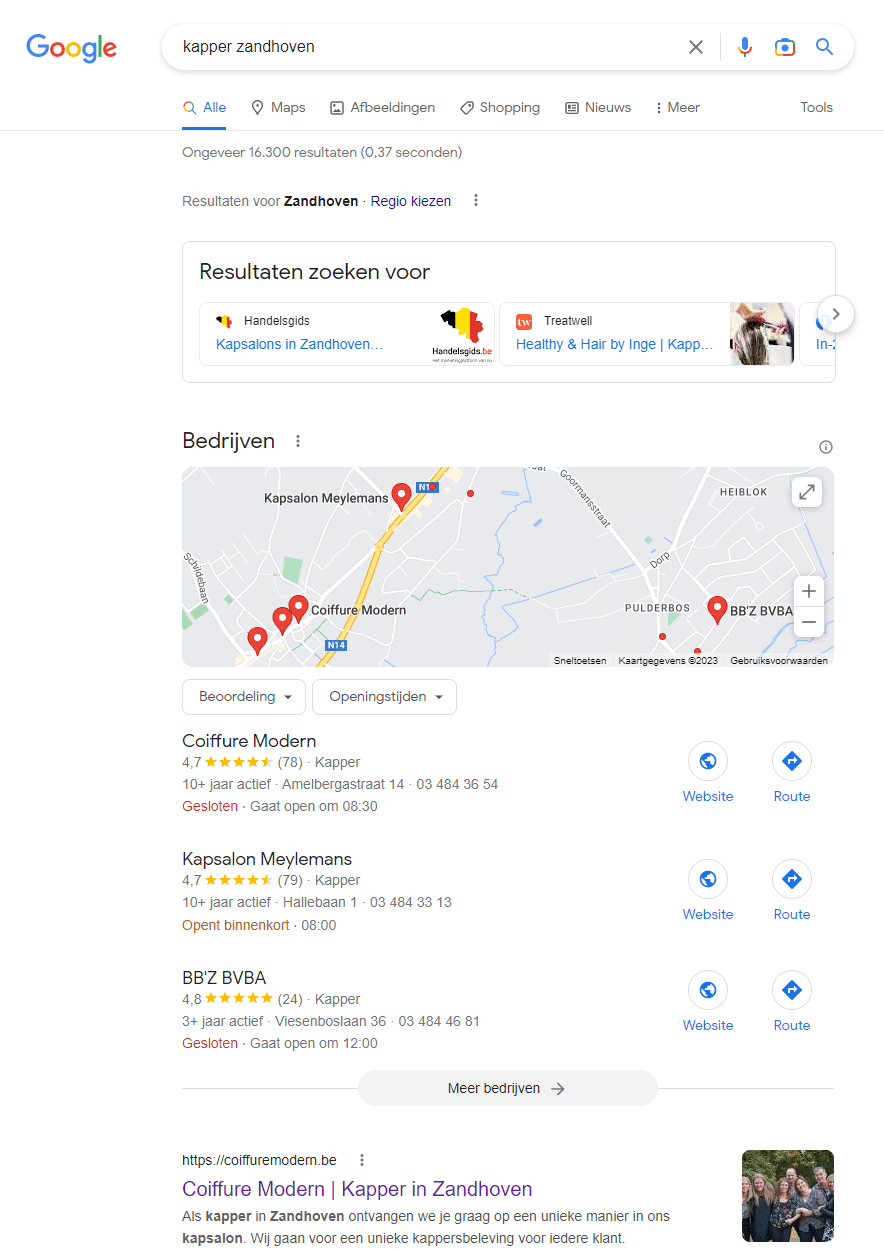
Don’t forget that there are synonyms for your keyword; you can rank for these with local SEO as well.
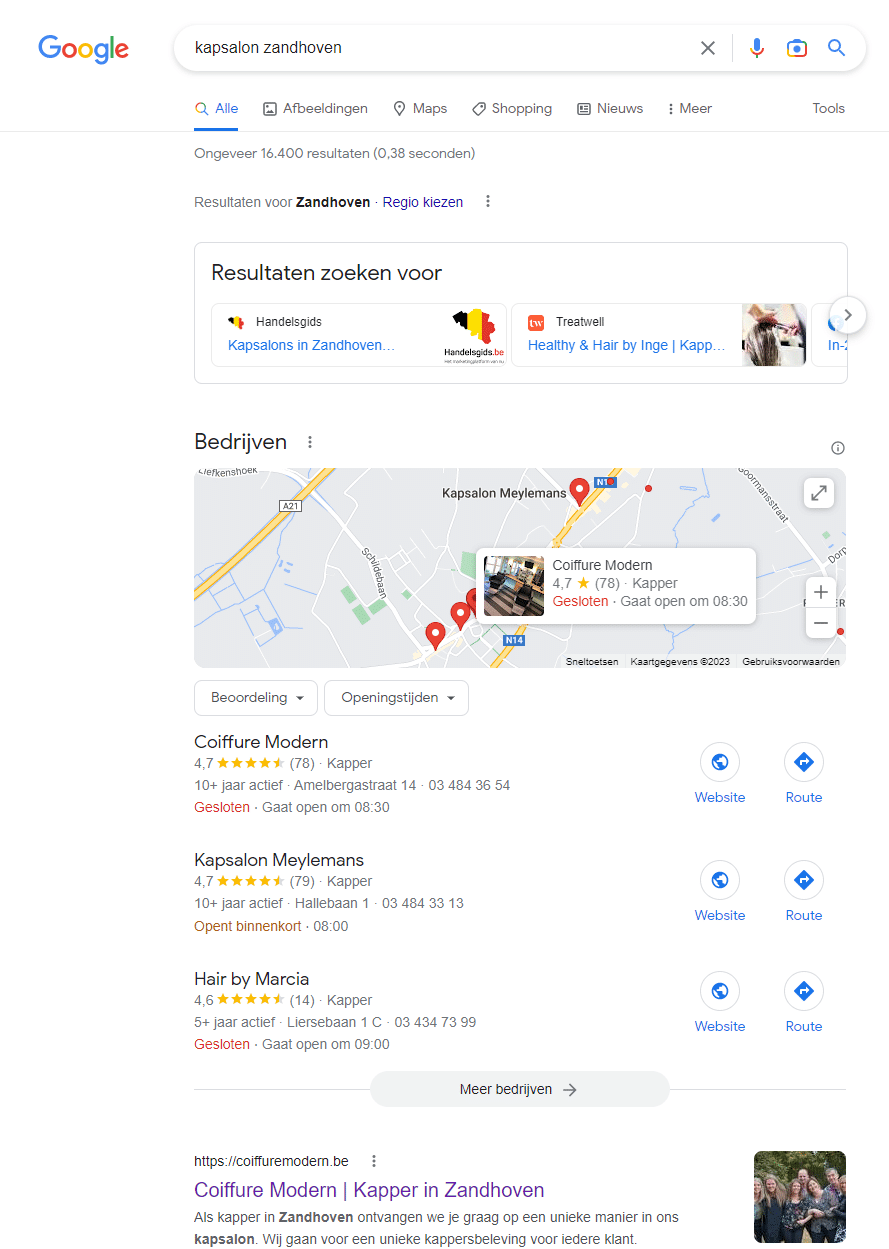
Note: We are performing this search from outside the municipality (Zandhoven).
Nearby when someone searches for keyword + “near me”
Improving the SEO of your business ensures more reach among actual locals. People from the region looking for a nearby business to help them. The chance that they’ll visit immediately or make an appointment is high.
Example: “hairdresser near me”
Further away when someone searches for keyword + municipality
These types of searches usually involve people who will visit the location in the future. Think of a restaurant for a weekend getaway or someone who heard about a shop in that municipality.
Additionally, local residents also search for their keyword in combination with their own municipality.
Example: “hairdresser Zandhoven”
General searches
For 90% of our clients, we work on general searches. It makes sense that these are searched for more often and therefore yield more results. We always include local SEO in the strategy because it’s a quick win. You only compete with local players, which means you’ll rank at the top much faster.
Example: “hairdresser” (when you are near Zandhoven)
SEO for your SME works incredibly well for local players. Businesses with a physical location or shop that people can actually visit. The average business sees quick results from its local SEO efforts.
For us, local SEO falls under “low-hanging fruit”. SEO is a long-term strategy, yet you can get quick results with the right local keywords.
Who is local SEO interesting for?
Every business benefits from the right local optimizations. While there might not be massive search volumes (how many people type in a keyword monthly), those local keywords bring you hyper-relevant traffic. Traffic that has a high chance of converting (becoming a customer). That’s why both SEO for the Kempen and SEO for Antwerp are very interesting.
SEO and SEA go hand in hand. For your local strategy, there are some nuances to consider.
With SEA you can set your region, with SEO you can’t
With SEA, you can perfectly indicate the municipalities in which you want to show your ads. With SEO, you are dependent on your optimizations and how someone searches (actually searching for your region). One isn’t better than the other in this case; the approach is just different.
With local SEA you pay per click
While you pay for every website visitor with SEA, SEO provides free visitors. With SEO, you do have to work on your website first. Depending on your ambitions, you can get started with both at the same time.
Local SEO works according to the technical SEO factors as “standard” SEO. You basically follow the same steps as for a classic optimization.
- Your website must be technically sound
- Your website architecture is logically structured
- Your content tells something useful
- High-quality and relevant backlinks to improve your authority
On top of that, you add a local focus. It’s as simple as that.
Note:
Many companies try to create a page for every municipality to rank everywhere. While this tactic can work in some cases, we usually advise against it. You can perfectly include adjacent municipalities and regions.
Depending on your focus, it might not be relevant at all to rank in a city 100km away.
So define your target audience very clearly, what you want to achieve, and which municipalities are relevant.
You start, as always, with a keyword research. This allows you to find relevant searches and uncover the search volumes. You then mirror each of those search terms with the local variant.
For example, “hairdresser”, which is searched for 47,000 times a month, becomes “hairdresser Zandhoven”, which is searched for 300 times a month. For this specific hairdresser, it’s not interesting to be found in Ghent, even if there’s more search volume there.
Your keyword research therefore focuses mainly on general keywords, synonyms, and related questions to answer. Afterwards, you add your local focus to that.
“Hair salon” is searched for 23,000 times a month. Quite a bit less than “hairdresser”. This will therefore be our main keyword. We apply this trend to our local keywords.
Being found in the region is a great added value. For many businesses, local customers are still the most important. You can attract more local customers with local SEO, and you might even set up a local ad campaign with Google Ads.
Don’t forget that search engines are only one part of your overarching strategy. Think about social media, emails, flyers… You can do a lot to reach local customers. We believe that local SEO is one of the most cost-effective ways to do that.
Developing your local SEO strategy starts with gathering data, getting to know your target audience, and creating a clear roadmap.
1) Define your target audience
Which region, municipalities, or cities do your customers come from? What distance are they willing to travel to reach you? Be critical and don’t go too broad.
2) Use your keyword research
Determine which keywords you want to rank for, who is ranking now, and how you can start ranking for them too. Form a picture of what is needed to score higher in search engines, keeping your focus clearly on local search terms.
3) Create a roadmap
List the required actions to score higher. In the next section, we’ll walk you through the general steps you can take. Every situation is different. Use the steps for inspiration, but also think carefully about your situation and your customers.
1) Put the basic information correctly on your website
Ensure correct contact details. Mention your phone number, email, full address, and your VAT number (the latter is required by law, by the way). You might even add a Google Maps integration; this helps your visitors visualize your location.
Mention these details in:
- Your footer (at the bottom of every page)
- Your contact page
Optionally, add your email and phone number to your menu and use them throughout your website. This makes it easy for potential customers to contact you. Critically weigh (and look at the data) how customers contact you most.
Tip:
Make sure all your contact details are the same everywhere. On your website, in your Google Business Profile, on your socials, …
2) Create a Google Business Profile listing
You can register your business with Google. It really doesn’t get easier than that. Create your Google Business Profile and provide all the information. From time to time, you can optimize your Google Business Profile.
Tip:
This is the easiest quick win to implement. Provide accurate data to Google, and they’ll include your business in Google Maps. You will need to verify your location.
3) Register your business with local directories
There are many local search websites. Register your business with these directories. Usually, these are free (or the free listing is sufficient). Two birds with one stone: you build authority & credibility with Google, and customers can also find your business through the platforms themselves.
Platforms where you can register:
- Handelsgids
- Yelp
- Unizo
- Your municipality’s website (they usually have an overview of local entrepreneurs)
- Social media
4) Use structured data (schema.org)
With structured data, you provide information to search engines in a universal format. This is useful because it helps them easily understand what you mean. With the “local business” format, you can easily provide all the details.
Tip:
Structured data is quite technical; use our structured data generator to easily generate error-free code.
5) Optimize content
What can be read on your website is and remains enormously important. The content on your website must therefore really be spot on. Want to be found at a local level? Then you need to incorporate the location into your content.
Incorporate your keyword and location into your content:
- In your page title and description
- In the H1 of your page
- In your subheadings
- Throughout the text
- Behind your images (alt text)
Make sure you have the basics right. So your address and contact details are mentioned in your footer and on your contact page.
6) Attract local backlinks
To build authority, you need to invest in linkbuilding. Don’t forget your local focus here either. For example, we recommend sponsoring local events, associations, or initiatives. In return, you often get a mention of your logo on the flyers and website. Be sure to ask them to include a link to your website.
Again, a double win. Your business is shown to your local target audience in the short term, and you get a backlink in the long term. A nice bonus, right?
7) Technical SEO
SEO rests on 3 pillars (technology, content, and authority). We often use the comparison with a car to explain exactly what SEO is. The technical pillar remains an important part. If that’s not right, all the above steps are hopeless. You can’t build on your content and authority if your foundation is full of technical SEO problems.
Start at the beginning and build from there.
Google reviews are always important; they build trust with your future customer. Reviews also have added value for local SEO. For instance, you can collect reviews on your Google Business Profile listing.
We notice that these reviews help determine which keywords you are shown for. Additionally, businesses without reviews are shown less often.
Approach your customers and ask them for an honest review. It helps your business (beyond SEO) move forward significantly. Want to remove fake or false Google reviews? We’ll guide you through the process.
Not convinced about local SEO yet? Let us add a bit of motivation. We see local SEO paying off like kids in a candy store. Organizations that want to capture their target audience are best off investing in local SEO. By capturing, we mean that people indicate themselves that they are looking for something and you offer them the solution. No pushy sales techniques, just genuine help.
SEO is one of the most profitable marketing techniques. Local SEO goes one step further. You often have less competition and therefore achieve great results.
Where a refrigerator salesman has to compete against the giant webshops, he often has the playing field in the region all to himself.
So with local SEO, you can compete against the big players. You are limited to the region you’re in, though for many traders, that’s exactly the point.
You can work on your local findability yourself. This article already gives you a first look and tips to attract local traffic. Don’t stop here and also include general SEO principles and optimizations in your website. You’ll find all the tips and tricks on our website. We’re happy to help you on your way.
Don’t have the time, interest, or are you getting stuck? Then we are of course ready to help you rank higher in the local search results.
Table of Contents
- What is local SEO?
- What does local SEO look like?
- Different ways to rank with local SEO
- The added value of local findability
- Local SEO and SEA
- How does local SEO work?
- Keywords with a regional focus
- Developing a local SEO strategy
- Local SEO in practice: 7 steps
- The impact of reviews on local SEO
- Why invest in local SEO?
- Do local SEO yourself or outsource it?