
Helpful Content Guide
Helpful content: the oldest SEO trend
In August 2022, Google will launch the first Helpful Content Update. It will be updated in December 2022 and September 2023. Google clearly places a high priority on helpful content for its users. Should you be concerned about your website? And how do you optimize your pages with the right content? We answer your questions in this white paper (which, by the way, is a wonderful example of helpful content itself).
“Helpful content” or “people-first content” is useful, reliable information that helps people first and foremost. When Google announced the first update in the spring of 2022, it caused quite a stir among SEO specialists. What major change would this new concept bring about?
Just to clarify: when the first Helpful Content Update was released, it caused quite a stir among so-called SEO specialists. Helpful content is really just a new name for an existing concept. Anyone who follows SEO “best practices” has nothing to worry about when it comes to helpful content.
In that case , you’re already creating useful content. You rank highly in search results because you’re providing what Google wants to offer its users—not because of black-hat SEO techniques. This way, you align seamlessly with the mission Google has set for itself.
Don’t feel the need to follow Google’s lead, but want to rank at the top of search results? Let us handle your SEO.
Everyone wants something from Google, but what does Google want? “To brainwash us by manipulating their search results!” some people claim. “Spying on us for the U.S. military!” others are certain. “Throwing our privacy to the wolves in exchange for a massive amount of money!” says a third group of conspiracy theorists. Spoiler alert: they’re all wrong.
Google itself sums it up succinctly. Their “About” page revolves around a single line:

The products Google develops—such as Maps, Gmail, and Chrome—have one goal: to make users’ lives easier. It’s an ambitious and noble ideal, but above all, it’s a great starting point for SEO. Keep Google’s mission in mind when creating online content, and you’ll be on the right track. With relevant information that’s easy to find, you’ll be in the clear with every new update.

This Helpful Content Update is a logical next step in Google’s updates. To provide its users with the best possible answers, the search engine continues to focus on high-quality content and relevant linkbuilding.
With this update, Google is continuing its mission to make all the world’s information as accessible as possible. To that end, it is even deploying new resources. For example, E-A-T has been expanded to E-E-A-T.
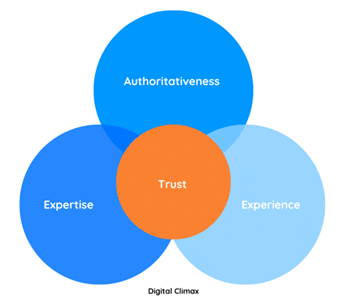
December 2022. Google adds “E” to its E-A-T. This has nothing to do with good food, but everything to do with Expertise, Authoritativeness, and Trustworthiness.
Expertise is all about the author’s qualifications, knowledge, and credentials. When it comes to authority, Google looks at how strong your reputation is within your niche (based, among other things, on backlinks). Trustworthiness is the most important—and most difficult—factor.
Meanwhile, E-A-T has been expanded to E-E-A-T. “Experience” refers to firsthand experience. A reviewer who posts photos of the hotel where they stayed, a financial expert who shows which stocks they personally invest in, or an SEO specialist who shares their proven techniques with their followers.
E-E-A-T is not a ranking factor
Important to remember: E-E-A-T is not a direct ranking factor that the algorithm uses to determine your position in the search results. It is, however, part of the Search Quality Rater Guidelines. Google employees use this manual to evaluate the quality of search results.
These “quality raters” check whether a website meets the E-E-A-T criteria. The success of updates is evaluated based on their feedback. In addition, this feedback is used to train the machine learning system that also evaluates your site.
In short: Focus on E-E-A-T, and you’ll have a better chance of ranking higher in search results.
People who search on Google want the best possible answer. That’s why Google prioritizes websites that help searchers. But how do you create helpful content yourself? Our SEO copywriters are happy to help you get started.
Put your visitors first
SEO content is online content that has been optimized to rank higher in search engines. But “optimizing” is not the same as “cheating.” Google prefers to place the perfect web page for its users at the top, not the perfect web page for search engines. In fact, websites that optimize purely for Google are severely penalized and end up achieving the opposite of what they hope for.
So, first and foremost, write for your readers, not for Google. Help your visitors move forward and keep the rules of SEO in mind. That’s all you need to rank highly. This isn’t exactly breaking news. Google and we’ve been saying this for years. Helpful content is, after all, the oldest SEO trend. And if that’s not the case for you, this is the perfect wake-up call.
Ditch vanity metrics
“I had a lot more to say, but an online text can’t be longer than two A4 pages, so I’ll put the rest on another page.”
“I crammed my keyword into my text a few more times, and then the plugin’s indicator turned green, so I’m in the clear now.”
“My website has a domain authority score of 93; I can publish whatever I want, and it appears on the first page of Google.”
Clichés like the one above have been making our hair stand on end for years. Google’s update on helpful content once again highlights how wrong those who promote them are. Focus primarily on the quality of your content, not on the numbers behind it. Those are a guideline, not a goal.
We like to lead by example. Green, orange, and red dots in plug-ins indicate areas that could be improved, but there’s no point in trying to make them all perfect.
Write for people, incorporate your keyword naturally into your text, and make logical connections. That way, the quality of your content will improve without you even realizing it.
And just a heads-up: this article completely ignores all those so-called maximum word counts. Want to bet we’ll still rank for “helpful content”?

Dig Deep into Search Intent
Why are you searching? Well, to find something, of course. But what are you hoping to find? What’s the question behind your search? That’s what Google tries to figure out with every search query. Based on that, search queries are divided into four categories that fit perfectly into the AIDA model.
- Informational: The searcher wants to find out who, what, where, when, and why. For example, “Who invented peanut butter?” This way, the searcher will take notice of you.
- Navigating: The searcher is looking for something specific, such as a website like “calve.nl.” Meanwhile, they become interested in your product.
- Commercial: The searcher conducts a search, for example, “compare types of peanut butter.” Theirdesire to take action increases.
- Transactional: The searcher wants to buy something, have it delivered, rent something… For example, “buy peanut butter.” Finally, they’re ready to take action!
Depending on your search intent, Google displays different results. The search engine often answers an informational query itself (with “Marcellus Gilmore Edson” in our example), whereas a transactional query primarily brings up product pages.
How do you respond to this? By providing the best answers to the questions asked by your visitors, your customers, and your leads. Do you have an online store selling skincare products? In that case, a blog can help boost your authority (which is important for SEO), but it probably won’t get you onto the first page of Google. That’s because the first page is dominated by your competitors’ online stores.
In short: Unraveling the search intent of your future customers is one of the most important factors in your keyword research. And capitalizing on it is worth its weight in gold.
Focus, focus, and more focus
Anyone who searches is looking for an answer to their question. Nothing more, nothing less. So give them the answer to that question. Don’t digress, don’t bring up 101 other topics— stick to one topic per page.
“Yeah, but we sell the best peanut butter—and we also have delicious chocolate. Have you tried our honey yet? We make it ourselves from the nectar of our own bees…” Perfect! Then write one blog post about that best peanut butter, another about the delicious chocolate, and a third about the homemade honey.
How do you keep seeing the forest for the trees? Thanks to content clusters, of course. Start with your well-organized website architecture, group related topics together, and connect them with internal links. By presenting your helpful content this way, you’ll be doing your visitors and search engines a big favor.
Work on your authority
In the beginning, Google primarily assessed the relevance of websites based on the number of backlinks they had. Since then, authority has evolved into a full-fledged pillar of SEO, alongside technical factors and content—a pillar that encompasses much more than just linkbuilding.
Take “topical authority,” for example. As an entrepreneur, you’re the go-to expert when it comes to your product or service. People hang on your every word to find out the truth. Now it’s just a matter of making that clear to the search engines.
To do this, let’s go back to our previous tips. Put your visitors first, dig deep into your customers’ search intent, and focus on one topic per page. Then write about everything related to your product or service: what it is, what the benefits are, exactly how it works, what it’s used for, who uses it…
Sure, that’s a little scary. It’s almost like throwing your trade secrets out on the street. But sharing your knowledge online is an incredibly powerful content marketing strategy. You demonstrate your expertise and experience (two of the four E-E-A-T factors) to search engines. Plus, you can repurpose your published content elsewhere, such as on social media, in newsletters, or as guest posts.
Go for quality
Here’s another one we’ve been absolutely convinced of since the very beginning. Cheaters get caught sooner or later. With quality, you’ll keep scoring (more and more). Share your expertise and create content that you’d want to read yourself (what do you think we’re doing right now?). That way, you’ll naturally attract visitors, customers, and leads over time.
Want to whip up a few articles today and be at the top of Google tomorrow? Of course, it doesn’t work that way. Creating helpful content takes time—a lot of time. Time that you can’t (entirely) outsource and that, on top of that, doesn’t seem to pay off immediately. SEO remains a long-term strategy; there’s (unfortunately) no magic button or secret trick. But as you know by now: persistence pays off.

All right, you’re up to date with the latest changes, the possibilities of helpful content are wide open for you, and our recommendations are saved on your hard drive. Ready to help your customers, search engines, and yourself? With these tips, you can get started right away.
Forget Google
First things first: forget Google—write for your target audience. Ask yourself these questions before you open your Word document.
- Would you write this blog if search engines didn’t exist?
- Would you publish this blog post if search engines didn’t exist?
- Is your customer satisfied with the information you provide?
If the answer to any of those questions is “no,” there’s a good chance you’re not writing helpful content. It’s better to start with what your visitor wants to read— what they need to know. Combine that search intent with your information and the rules of SEO. That’s how you create fantastic content that’s also helpful.
Show that you’re an expert by experience
E-E-A-T isn’t just a random acronym. Through expertise and experience, you build authority and, ultimately, trustworthiness. So be sure to showcase your experience and expertise. As easy and tempting as it may be, don’t copy product information from your supplier onto your website. Unless you have an exclusivity agreement, the exact same text—sometimes poorly translated—appears on hundreds of other pages.
Avoid dry information; provide insights that show you know what you’re talking about. Everyone sells white sneakers, but you know which outfits they go with and how to clean and care for them. That’s how you create helpful content that adds incredible value when combined with all your other SEO efforts.
Make a Name for Yourself
Is the perfect article—one that answers all of your target audience’s questions (or rather, one specific question)—ready to be published? If so, make sure it’s clear who wrote this helpful content.
Mention the author, both in the metadata and on your page. And create an author page where you introduce all the authors and list their articles. This is also a great way to further build out your internal links.
Make sure search engines understand that you’re a real person. Include contact information on your pages, such as your address, phone number, email address, and social media accounts. You’ll help Google—and yourself—even more by registering your Google My Business listing.

Stay up to date
The Google Helpful Content Update is a “site-wide” update. In other words, a single article that Google deems unhelpful can drag down the rankings of your entire website. Remove old or outdated content, or update it to ensure it’s high-quality.
As an interior designer, have you always kept up with the “helpful content” trend and written a blog post titled “The Five Interior Design Trends for 2019”? Nice work! But now it’s time to update that post. No one’s interested in trends from five years ago anymore.
So write a new blog post to replace the old one. Be sure to carefully consider whether to include a year or date in your URL. That makes updating more difficult, since you’ll always have to set up a redirect.
Help in all areas
Helpful content won’t help if your page is painful to look at or doesn’t work. So make sure you provide the best possible online experience for your visitors. This means not only clear, focused content, but also your technical SEO: your website’s layout, how fast it loads, and whether all links are clickable.
Google places great importance on the user-friendliness of your website. Improving your pages always has a positive impact on your rankings. Visitors want content that works, is relevant, and conveys reliability. That’s right: technology, content, and authority—the three pillars of SEO. Search engine optimization isn’t just about ranking higher in Google; it’s also about improving your website.
Google isn’t just rolling out Helpful Content Updates. The search engine also helps you assess for yourself how well you’re doing. You can do this using this comprehensive checklist for creating helpful content.
Content & Quality
In terms of content and quality, your content should best meet the following criteria:
- original, interesting, or insightful information, reporting, research, or analysis
- a complete or at least detailed description of the topic
- provide added value compared to other pages in the search results, rather than copying, rewriting, or summarizing other sources
- a headline or page title that isn’t exaggerated or sensational, but provides a useful summary of the content
- a page you’d like to save or share yourself, and one that wouldn’t look out of place in a magazine or book
- carefully produced, with no spelling or stylistic errors
Expertise
Google considers content from experts to be reliable information. Therefore, make sure your text meets the following criteria:
- includes clear sources, evidence of expertise, and background information about the author or website (for example, links to an author page, an information page, or an “About Us” page)
- A reliable and authoritative look and feel for the website
- written or reviewed by an expert with proven knowledge of the subject
- without factual errors that can be easily refuted
People First
Google prefers content that is created for people, not to influence search results. You can recognize this content by the following characteristics:
- written for an interested audience
- clearly demonstrates firsthand expertise and in-depth knowledge
- provides sufficient information on a topic to help the reader move forward
- provides the reader with a satisfying experience
- focuses on a limited number of topics, rather than on as many as possible in the hope that some of them will be successful
- Your expertise is what matters—not what’s trendy or what might attract a lot of visitors
- is not limited by a maximum number of words imposed by Google (because it doesn’t do that)
- provides concrete answers to concrete questions, not unfounded guesswork
- provides up-to-date information instead of old content with only the date changed
The answer to all your questions
The more boxes you checked above, the better your content helps your visitors. Another way to check whether your content meets search engine criteria is to ask yourself these three questions.
- Who wrote the content? Is it immediately clear who wrote your text, is the author’s name listed, and does it link to more information about the writer?
- How was the content written? For example, in reviews, specify how many products you tested and how you tested them.
- Why was the content written? Hopefully, the answer is “to help my visitors”—if so, you’re fully in line with E-E-A-T.
You’ll find helpful content under the second SEO pillar, content (which makes sense). The other two— technology and authority—remain important as well. A helpful article with two H1 tags, hardly any internal links, and nothing but plain text has little chance of ranking at the top of the search results.
As an SEO agency, we approach the three pillars of SEO chronologically. First, we optimize your website from a technical standpoint; next, we provide relevant content; and finally, we build your authority. Experience has taught us that mixing these steps up has a negative impact on SEO. Even when you offer helpful content, it’s best to ensure you’re using the right architecture, code, headings, and so on…

If everything goes well, that won’t be necessary at all. Good content is the foundation of every step we take and recommend to others. Loyal followers like you have usually been creating it for a long time already.
Is it just now sinking in, and are you ready to optimize your website for helpful content? If so, take a step back first. Evaluate your pages and see where corrections are needed.
Prioritize what’s most urgent. It’s better to update a blog post about the best diesel commercial vehicles sooner rather than later than generic product information about your auto parts.
Content marketing involves creating and sharing knowledge in the form of helpful content. This helps you build authority and become a thought leader for your target audience. Think of it as a giant magnet that grows stronger as your authority increases, attracting more and more visitors, leads, and revenue.
When it comes to content that helps your visitors, blogs are probably the first thing that comes to mind. But other pages on your website are also ripe for optimization. Category and product pages often have an even faster and greater impact on your business. Check out how you can offer your visitors helpful content here, too.
On the drawing paper page of your arts and crafts online store, explain the differences between the products, what they’re used for, and which product is best suited for each application… Providing high-quality information remains the common thread.
Putting an author’s name on a page like that, however, is a step too far. The goal here is to provide helpful content to customers, not to establish your reputation as an expert in the field.
Keep your CRO in mind
You publish your helpful content, and Google discovers a new expert in its niche. Your pages shoot to the top of the search results, and online visitors start pouring in. Great! Now it’s important to make sure they not only benefit from your expertise but also take action.
Enter conversion optimization, or CRO (Conversion Rate Optimization). With it, for every 100 visitors, you’ll get not just one inquiry or order, but two or three (and in rare cases, even five). Focusing on attracting more visitors is good, but don’t forget to improve your CRO as well.
The big question, then, is how we can convert more visitors into customers. To do that, you first need to apply a number of proven SEO techniques. Make sure you have buttons that work, pages that load quickly, and clear paths to placing an order or getting in touch. SEO helps you improve your website and, in turn, your CRO.
Practice what you preach. That’s why our best example of helpful content is Digital Climax. These are just a few examples of how we ourselves respond to Google’s desire for helpful content that takes E-E-A-T into account: experience, expertise, authority, and trustworthiness.
- Authors: At the bottom of every page on our website, you’ll see who wrote the article, along with additional biographical information and links to social media accounts that demonstrate his or her expertise. If you click on the author’s name, you’ll be taken to our author page, which includes links to all the articles each author has published online.
- Portfolio: Successful projects build trust with new visitors and clearly demonstrate your expertise. That’s why we compile specific case studies—complete with explanations, statistics, and quotes—in our online portfolio.
- Updating Old Content: Is Google rolling out an update that will shake up search results? You can read all about it in a news article, hot off the press. Plus, we’re constantly updating our overview of Google Updates. That way, the updates themselves stay up to date, too.
- Experience: You can also subtly convey this in your content. For example, use phrases like “our experience shows that…,” “in practice, it turns out that…,” “many people say X, but we’ve noticed that Y”… Google is smart enough to pick up on these and interpret them.
- High-quality linkbuilding: By adopting content marketing as a strategy, you share valuable content that others are eager to link to. For example, we launched the Structured Data Generator, which boosted our Domain Rating within a few weeks.
Is AI-generated content helpful content?
We’d like to bring up our SEO cliché once again: it depends. Content created by artificial intelligence isn’t necessarily bad. We actually like to use it as inspiration ourselves. Our copywriters then get to work with that AI copywriting input. Because human-written text remains more engaging than computer-generated content.
Don’t use AI-generated content directly on your web pages. That’s because it never reflects your personal expertise and experience—and those are exactly what’s essential for helpful content. What’s more, there’s a chance your competitors might have the exact same idea, which could lead to you suddenly publishing the same monotonous content. And that does more harm than good.
Google itself takes a two-pronged approach to AI-generated content. It updated its helpful content guidelines: previously, they read “content written by humans,” but now they simply say “high-quality content.”
On the other hand, Google says that AI-generated content is acceptable as long as this is made clear to the visitor. Using AI-generated content to generate, for example, hundreds of product descriptions is not encouraged. Google considers this to be manipulation of search results and a violation of its spam guidelines.
In short: AI is an interesting technology that offers a lot of inspiration for content creation, but it’s best to use it with caution.
How does Digital Climax help you create helpful content?
As an SEO agency, we work every day to help our clients rank higher on Google. We do this by adapting to Google’s algorithm. We focus on technical optimizations, content marketing, linkbuilding, conversion optimization, local SEO… In short, we do everything we can to get you to the top of Google.
Helpful content is one of our key priorities. We get to know your business, share your expertise with your target audience, and thereby ensure higher search rankings. We’re huge believers in helpful content because Google believes in it, and because we’ve seen that it works—both for us and for our clients.
At Digital Climax, we deploy experts in every field across all SEO pillars—from technical aspects to content and authority. This helps your website climb the search rankings over the long term, resulting in more visitors, more leads, and more revenue.
Table of Contents: Helpful Content Guide
- What is helpful content?
- Helpful content and Google’s mission
- So why a Helpful Content Update?
- E-A-T vs. E-E-A-T
- Optimizing Your Site for Helpful Content
- Put your visitors first
- Ditch vanity metrics
- Dig Deep into Search Intent
- Focus, focus, and more focus
- Work on your authority
- Go for quality
- Tips for Creating Helpful Content
- Forget Google
- Show that you’re an expert by experience
- Make a Name for Yourself
- Stay up to date
- Help in all areas
- Helpful content: The Google Checklist
- The basics remain important
- How do you adjust your content marketing strategy to focus on helpful content?
- SEO isn’t just about blogging
- Case Study: How We Deliver Helpful Content
- FAQ About Helpful Content