
Content Marketing as a Magnet for Your Customers
Content marketing is the creation of content to promote your business. It is therefore part of your inbound marketing strategy, which attracts customers with content that is relevant to them.
By creating and promoting content, you’re essentially setting up a giant magnet. That magnet gets stronger as you gain more authority, attracting more and more potential customers. Isn’t that better than hopelessly chasing after them?
“I’m a huge believer in content marketing—it’s the foundation of our marketing strategy. We start with SEO as the basis for our content marketing.”
Axl
In this guide, I’ll walk you through our process and give you everything you need to get started on your own. After all, that’s the foundation of content marketing: sharing knowledge, building authority, and becoming a thought leader for your target audience.
Marketing is as old as trade between people and has therefore evolved tremendously over the centuries. In the past, you’d place a billboard next to the road promoting your product with a discount. Today, the range of options is so vast and access to information so easy that your message simply gets lost in the crowd.
What hasn’t changed: People buy from people. We believe in that wholeheartedly. Customers want to be sure that your product or service will help them.
Enter content marketing.
By repeatedly sharing content that’s interesting to your target audience, you showcase your expertise and solutions. You help your customers and, in doing so, build trust.
Sales, sales, sales? It’s best to set that mindset aside when it comes to content marketing. Your primary goal should be to inform, not to sell. By helping your customers move forward time and time again, they’ll keep coming back to you.
Of course, that process is different for everyone. One person might recognize your value right away, while another might be more hesitant at first. Don’t worry: as you continue to build your powerful magnet, they’ll come.
So content marketing basically comes down to constantly planting seeds. Eventually, those seeds will sprout into something wonderful: a recommendation, a request for a quote, or a signed contract.
Can’t seem to turn off your inner salesperson? No problem, but in that case, there’s little point in reading any further. There are plenty of ways to sell directly. Content marketing, however, is based on a different principle. It does generate sales in the long run, but it doesn’t start from a sales-oriented mindset.
Okay, so building a magnet. How exactly does that work?
Create content and share it across various channels. This will establish you as the expert on a specific problem for your readers. Naturally, you’ll then be “top of mind” when they encounter that problem themselves. This increases your chances of being contacted.
Make effective use of different channels. Later in this guide, we provide a number of examples.
SEO is an important channel, but don’t limit yourself to search engines. As an SEO agency, we don’t do that either. However, we specialize in optimizing websites. That requires a lot of content, which you can also share on other channels (such as social media) to achieve results in the short term. Just make sure to always provide high-quality content.

When should you start content marketing?
I started doing content marketing almost right away. I tried cold calling for exactly one day—calling an unfamiliar contact and giving a sales pitch. That took a tremendous amount of energy, without much to show for it. Of course, it was all new to me back then.
Content marketing aligns better with the way I think. We attract customers who consciously choose our expertise, who already know us, and who understand what we stand for. That also turns some people off. Not everyone has the same mindset, and that’s perfectly fine.
And how do you get started with content marketing?
The good news: you can handle content marketing entirely on your own. After all, you’re the expert. Creating content that addresses your target audience’s problem isn’t “rocket science.” But getting a crystal-clear understanding of that problem is often difficult.
The most important tip: just get started. After all, you need to plant the seeds, and they need time to sprout.
Publishing this guide won’t immediately bring me new requests. If you read it all the way through, you’ll be able to proceed on your own, even without us.
But that changes again within a few weeks, months, or years. “I don’t have enough time to create that content.” Or “It’s hard to keep up with all the content marketing trends.” To get back to focusing fully on your business, you decide to bring in experts. And in the meantime, we’ve continued to share our knowledge with you, keeping us at the forefront of your mind.
Don’t get stuck in a “one-man show” where you do everything yourself. This applies not only to content marketing but to your entire business. Focus on what you enjoy doing and are good at. That often pays off more than trying to save money by doing everything yourself.
Thought Leadership Through Content Marketing
Content marketing is the means; thought leadership is the goal. Build your expertise so that people associate you with the solution.
By “thought leadership,” we mean that others regard you as an expert in a particular field. This can range from SEO to machine parts. You can use content marketing in both areas to ensure that potential customers see you as the expert in the field.
Content marketing works over the long term. You build your thought leadership status by consistently providing value to your target audience. They come to associate you with a specific topic or solution. By maintaining a regular presence, they’ll think of you when it really matters.
Let’s say your Google rankings could use a boost. You’re more likely to think of us again after reading this guide. And then we can schedule an introductory meeting and prepare a quote for you.
Whether we’ll actually end up working together is another story. But we’ve been building our authority for several years now by consistently providing you with SEO tips, insights, and problems along with their solutions. So the chances of a positive response are much higher.
Before people decide to work together, they go through various stages. Yes, there are 1,001 different models for this. AIDA best aligns with our perspective.
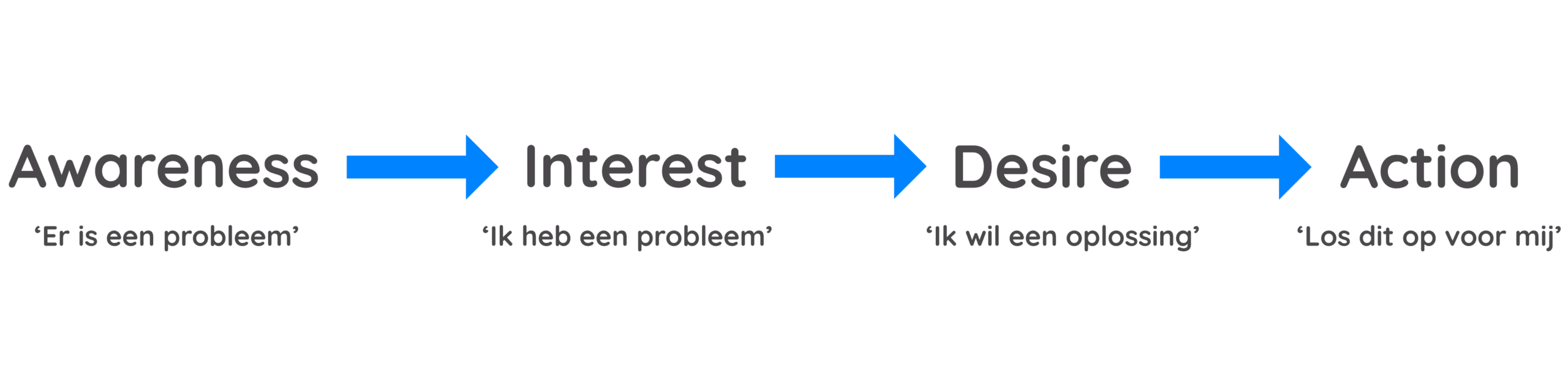
Awareness
If your customers don’t know who you are, they can’t choose you. The first step is to make sure they know you exist—and that they come to see you as the expert with the solution to a specific problem.
Interest
Slowly but surely, they’re beginning to realize that they, too, are facing this problem. Sometimes you’ll get a question via email, or someone will sign up for the newsletter.
Hold your horses! Don’t rush into this with your sales department just yet. Instead, continue to build your thought leadership by answering these questions.
Desire
Now it’s clear: your target audience is facing a problem and doesn’t have enough time or expertise to solve it on their own. If they want help, they need to take action.
Action
A phone call to get acquainted, an email requesting a quote… Your prospective customer is the one who clearly signals that they’re ready to buy. Be careful not to shift from attracting them to pushing them too hard at this stage.
Tip
Apply these stages to your SEO as well. Choose keywords that align with the stage your target audience is in, and tailor your content accordingly.
Anyone who enters a query into a search engine does so with a specific goal in mind.
That search intent and the associated keywords differ at each stage. In the Awareness stage, searches are driven by a problem. The answer is an effective solution.
In the Desire and Action phases, on the other hand, searches are conducted using highly commercial keywords. Each phase requires a different type of content. That’s why we view SEO as the foundation of your (content) marketing. Maybe it’s a bit of professional bias, but it’s also the harsh reality.
In principle, everything you create content for is part of “content marketing.” You use these channels to share your expertise.
1) SEO
Let’s start with our “little thing.” SEO is our world, and our world is SEO.
This component forms the foundation of our content marketing strategy. We start with keywords to find inspiration, structure our articles according to SEO best practices, and focus on high-quality content.
2) Social media
Posting on social media monthly, weekly, or even more frequently adds tremendous value. This is the ideal way to maintain a regular presence. Your target audience will remember you better than if you only appear once through an SEO article.
3) Newsletter
Newsletters also play a role. Again, focus on creating added value. So no boring company news or just discounts. Through newsletters, you can follow up with (potential) leads in a more personalized way and offer them interesting content.
4) Podcast
A podcast falls into the Awareness & Interest phase. This is the ideal platform for sharing your knowledge and experience. People often listen to podcasts while walking, biking, or driving. They guarantee you an exceptionally long attention span. This makes them perfect for diving into a topic in detail.
5) YouTube
Video works. YouTube is the second-largest search engine, making it a great platform for sharing your content. Create videos as part of your blog posts, or record your podcast as a video and share clips from it on social media afterward. Learn all about video SEO.
Tip
Sales have been put on hold for a while, but don’t forget they’re still there. Creating added value is the main goal of content marketing. However, without occasionally driving sales, that’s as far as it goes—and that would be a shame.
- Video
- Copy
- Audio
- Images
The different types of content marketing complement each other; you can even combine them. Take photos to go with your blog post, base your podcast on a video… Share your content across all your channels.
By now, it should be clear: we believe in content marketing. For us, SEO is the starting point. Let me explain exactly how that works and what results it delivers.
Content is one of the three pillars of SEO, along with technical aspects and authority. Authority in SEO has a very different meaning than the thought leadership you aim for with content marketing. In SEO, authority is primarily based on linkbuilding.
We write articles (like this one) to rank for a specific keyword—“content marketing” in this case. To do that, we create high-quality content that teaches you, the reader, something new. So it’s a nice bonus that we can also use it for our own content marketing.
We’ll post this guide on our website and make sure search engines include it in their results. This will drive traffic to our site in the long term. To achieve results in the short term as well, we’ll share it on LinkedIn. There, our followers can request it and receive it.
Will you decide today to turn everything upside down and go with content marketing? Probably not. Is it more likely that you’ll contact us now than before you read this guide? We’d say so. And if not, feel free to let us know 😉
So your entire SEO process is in good hands with us. We usually leave the steps shown here to your in-house marketing department. Think of sharing a video on your social media, including a blog post in your newsletter…
Those are entirely different areas of expertise. We’re experts in SEO, execute it down to the last detail, and offer advice on taking a broader view.
The strategy behind content marketing is simple: publish content. Ideally, high-quality content that helps the reader. No sales pitches—just useful information.
It’s also important to consider the format and the platform. Not every company needs to be on every platform. Where are your future customers, what challenges do they face, and how can your content help them? In a B2B environment, we tend to look to LinkedIn first, while visual products are best promoted on Instagram or TikTok.
Develop your content ideas in different formats, tailored to each platform. For example, TikTok expects short videos, Instagram works well with photos, YouTube prefers longer videos, and Google favors text.
The biggest pitfall of content marketing? At first, it doesn’t work. Or rather: it doesn’t seem to work. Makes sense, right? You’re just starting to publish; no one knows you or cares about your opinion or product, and you don’t quite know your target audience yet…
So there’s a chance you’ll quickly become discouraged by content marketing. But keep in mind that it’s a process of growth. Test and adjust, over and over again.
The sooner you start, the sooner you’ll start seeing results. Just know that those results might take a while to show up. So don’t give up, and stay consistent.
Tip
Losing your motivation? Give me a call! Or read this guide again. We’d love to give you the boost you need to keep going. Because, yes, content marketing really does work in the long run!
Only by publishing content can you get a handle on your target audience. You’ll learn what works and what doesn’t. From there, it’s easy: do more of what works and less of what doesn’t.

We, for our part, go back to the basics, and those basics are SEO. We use SEO tools to determine the search volumes for specific keywords. That way, we know which words people are familiar with and which they aren’t. That’s where we get our inspiration for writing blog posts. And, most importantly, it helps us decide what to write about in those blog posts.
Taking an SEO-focused approach works incredibly well for us. But of course, there are plenty of great alternatives.
Tools
Tools, tools, and more tools. There are thousands of them for content marketing. Think of SEO tools, social media planning tools, photo editing tools, CRM… Everyone has different preferences. So do your research and choose the tool that best fits your goals and your workflow.
Website
Your website is the central hub of your content marketing strategy. All traffic converges there. Your social media posts, SEO blogs, ads… They all direct your target audience to your online home. So a good website is essential. In fact, it’s better to have a strong website built (technically, UX, CRO…) before you even start your (content) marketing.
SEO
We say it everywhere: SEO is the foundation of marketing. It forces you to consider who your customers are and what problems they face. With SEO, we link that to search queries. If you take a broader view, you can also use those personas and problems to tailor your social media to your target audience.
You can easily turn blogs that are already in the pipeline for SEO into social media posts. Plus, they fit perfectly into your newsletters. You can even run ads on them. So that’s a lot of benefits all at once.
Still, you can tell that something is happening. At first, that shows up as engagement on your social media, people signing up for your newsletter, more visitors… And in the long run, it translates into more requests for quotes. Often, those seem to come “out of nowhere.” Of course, content marketers like you and me know better by now.
KPIs for Content Marketing
A lot of organizations fall into the trap of vanity metrics. Those don’t tell you anything at all about your business. Thousands of followers on Instagram are worthless if they don’t engage with you.
Dare to look at broader indicators such as revenue, growth… If those are (suddenly) on the rise, then you can start drawing conclusions. We like to link that data to channels that generate results, but that’s difficult in content marketing.
Here’s an example. You’ve published a new blog post about your product. One of your followers sees it on Facebook and shares it with a friend. That friend clicks through to your Instagram and starts following you there. Later, when they ask Google a question, the answer turns out to be from you. If they then type in a keyword with the intent to buy, there’s a good chance they’ll click on your Google ad to request a quote.
Kudos to Google Ads for delivering ROI. But there’s a whole process leading up to that decisive click. Even if your metrics suggest otherwise, shifting your entire budget to Google Ads will still yield significantly lower returns. So take a look at your overall costs and the return you’re getting from them.
By posting new content every week, people get to know you, see what you stand for, and appreciate your tips and expertise. It doesn’t really matter which platform you use. What’s more important is that you do something—and that you do it consistently.
After about six months, the first requests for quotes will start coming in. So keep at it and continue working to create a consistent whole.

What were the results during the first few months?
Nothing. Nada. Zero. Not a thing.
Extremely frustrating.
After six months to a year, someone would occasionally reach out tentatively to request a quote. Those weren’t always signed yet.
Today, we’ve been in business for more than five years. Every week, we receive inquiries “out of the blue.” It may seem like an overnight success, but it certainly isn’t.
An added benefit of content marketing: potential customers who request a quote but don’t follow through will continue to see your content. You keep sharing your tips and demonstrating your value. It’s not uncommon for a prospect to request a quote a year later and then go ahead and sign the contract.
Content marketing works in the B2B sector, too. We prove that ourselves every day. You just need a little more patience. Long sales cycles mean that results often take longer to materialize. That’s no problem, as long as you maintain a consistent presence.
Look at your ads through the same lens as your content marketing. The only difference is that you’re now pushing your content out through a high-pressure press instead of letting it grow organically.
However, don’t fall into the trap of focusing your ads on sales. Content marketing is a process; people don’t buy immediately from a complete stranger. An ad alone won’t make that difference either.
So advertising and content marketing aren’t an either-or situation. If you use them the right way, they actually reinforce each other.
- “The Ultimate Guide to Content Marketing in 2023 ” by HubSpot
- Content Marketing Made Simple: A Step-by-Step Guide by Neil Patel
- What Is Content Marketing? Definition, Importance, & Strategy Tips by the SemRush Team
Our top tip: Set aside a budget, start content marketing today, and never stop. Make time for it and ensure consistency over the long term. That’s the key to a return on investment. Because even though it’s hard to measure, the potential return is enormous.
Forget about selling; focus on sharing knowledge. Start with your target audience, work your way toward their problems, and link your solutions to them. Help people move forward with your content. You do this by delivering quality. So set aside the generic text generated by ChatGPT.
Yes, it’s tough. Yes, it’s frustrating. And yes, you’re bound to hit a rough patch. Probably more than once, too. When that happens, just take another look at this guide. Your efforts will pay off. I guarantee it.
Good luck!
Table of Contents: Content Marketing Guide
- What is content marketing?
- The Evolution of Marketing Toward Content
- Forget about sales
- The Principle Behind Content Marketing
- Why Does Content Marketing Work?
- The Stages of the Sales Cycle: AIDA
- Components of Content Marketing
- Types of Content Marketing
- Case Study: Content Marketing for Digital Climax
- Why do we focus exclusively on SEO?
- Your Content Marketing Strategy
- Consistency = the foundation of your strategy
- How do you get started with content marketing?
- Inspiration for Content Marketing
- What do you need for content marketing?
- Measuring the ROI of Content Marketing
- Increase Sales Through Content Marketing
- Why are we such strong believers in content marketing?
- Advertising vs. Content Marketing
- Read more about content marketing
- Our Vision (on Content Marketing)