
SEO during rebranding
A rebranding is a redesign of the brand identity of an existing company. This ranges from a redesign of the details on a product label to a completely new corporate look, including a new name.
There are various reasons for a rebranding: modernizing an outdated image, appealing to a new target audience, entering into a merger or acquisition, shaking off a negative reputation, distinguishing yourself more clearly from the competition…
A rebranding changes the communication between your company and your potential customers. A rebranding also has a major influence on your SEO. Changing your company name and hoping that visitors will find you organically again? You need a powerful strategy for that. Overhauling your brand identity without looking at SEO is therefore a bad plan. But what should you do instead?
Hanne loves dogs. After her studies, she founds Hanne’s Dog School. Her first customers are friends and family members. They spread Hanne’s good reputation. Soon her lesson schedules are full.
During the lessons, Hanne notices something. Many owners ask for sustainable alternatives to the industrial dog kibble and plastic toys they find in retail chains. Hanne spots a gap in the market, bakes her own dog biscuits, and distributes natural dog toys.
For these new activities, Hanne considers setting up new companies: Hanne’s Dog Biscuits and Hanne’s Dog Toys. Another option is to group everything under one name: Hanne’s Dog Heaven. But that means a new name, a new logo, a new website. As if she has to start from scratch.

Are you or your client facing a rebranding? We are happy to help you on your way with an SEO-proof rebranding. Thanks to this white paper, you will become aware of the (mainly technical) dangers, involving a new website architecture, updated content, and setting up redirects. You will discover our vision on SEO during rebranding and receive many practical tips.
Tip
Be sure to also read our SEO migration guide. In it, you will learn how to take your SEO efforts with you to your new website.
If Hanne doesn’t have enough time between giving lessons, baking biscuits, and selling toys, she’s best off outsourcing the SEO part of her rebranding to an SEO expert. Do you, like Hanne, want to stop worrying about your SEO? Contact us for a successful rebranding for you or your client.
Both processes aim to improve the look and image of a brand, but they work in different ways. Astrid Vanderborght from branding agency Studio Boiler provides an explanation.
Redesign
A redesign is focused on maintaining the recognition and continuity of an existing brand. It is a way to keep the visual identity of the brand modern and current, without drastic changes. The goal is usually to evolve with the times and trends. Think of an update to, for example, the logo, color schemes, typography, and other visual elements.
“The redesign of the Johnnie Walker logo is a good example of how a subtle but thoughtful design strengthens a brand’s message and identity,” says Astrid. “Johnnie Walker is known worldwide for its whisky products and has a rich history dating back to 1820. The original Johnnie Walker logo showed a man walking to the left. That is reminiscent of going back in time, to the past.”
The biggest change in the redesign of the logo is the man’s walking direction. “It was reversed, so he now walks to the right. That symbolizes a shift towards the future, prosperity, and success. Not a random decision, but a thoughtful choice to better reflect the core values of the Johnnie Walker brand. Furthermore, the slogan ‘Keep Walking’ was added to the logo. It fits seamlessly with the visual changes in the logo. A redesign that kept the recognizable elements, such as the walking man, while simultaneously giving a fresh and modern look to a brand with a rich history.”

Rebranding
A rebranding is a much bigger step and usually involves significant changes in the visual identity and even the core message of the brand. Rebranding often happens when a company undergoes significant changes, such as a shift in values, target audience, product offering, or business strategy.
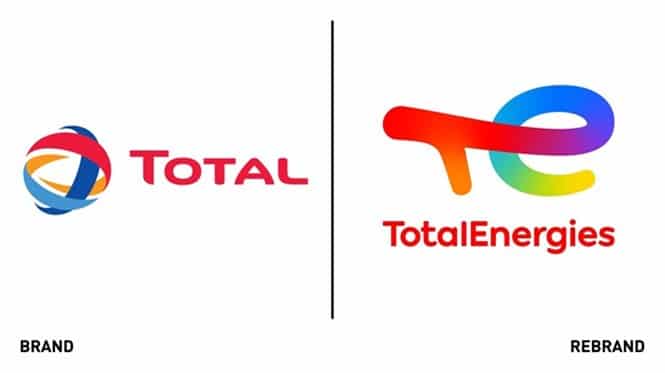
“In a rebranding process, the logo, name, colors, slogan, and other elements change drastically to reflect the brand’s new direction and message,” says Astrid. “An example of a rebranding is the transition from ‘Total’ to ‘TotalEnergies’, where the focus shifted from traditional oil and gas activities to renewable energy.”
Do you choose a redesign or a rebranding?
With both, it is essential that you think carefully about the impact of the changes and how existing and potential customers will receive them. A redesign maintains the foundation of the brand identity, while with a rebranding you take an entirely new course. The choice between the two depends on the specific goals and needs of the brand at that moment.
“When designing a branding, we strive to convey the essence of the brand in the right visual way, with the goal of appealing to the customer and the intended target group. Studio Boiler is known for its innovative designs that are simultaneously timeless, making the visual brand identity sustainable and lasting.”
Astrid Vanderborght, Studio Boiler
No matter how small or large your rebranding is, afterwards you ideally want to attract at least as many (and preferably even more) visitors, customers, and leads as before. Without good planning and the right steps in the right order, your rebranding risks costing you more than it brings in. Because your new name or ‘look’ is unknown to your target audience and to the search engines.
Crucial for SEO during a rebranding is therefore what you change and when. What is feasible from a business perspective? How important is SEO at which point in your trajectory? Attracting organic visitors is fantastic, unless they then end up on a website where 80% of the pages indicate they are still ‘under construction’.
Our rule of thumb: the fewer changes you implement at once, the better. Launching a new company name on a new domain with a new architecture, a new design, and new content all at once—of course, it’s possible. In that case, you can certainly expect a dip in your visitor numbers. Plan strategically what you execute and when.
We advise Hanne on a phased rollout. First, we put ‘www.hannes-hondenhemel.be’ online with the same architecture and content as ‘www.hannes-hondenschool.be’. Visitors who look closely will notice that the design has been slightly adjusted. Here and there, biscuits and toys are already appearing. These will come forward more prominently in the next phase, both in the design and in the content. Finally, we adjust the architecture so it’s clear that Hanne’s Dog Heaven offers training, biscuits, and toys. That’s the first thing visitors notice in the menu bar and on the homepage.

Finally, we can bring out our catchphrase again! Because it depends 😁 Specifically on what exactly you are going to adjust. The larger the rebranding, the more things you change and the more things you have to think about.
Whichever way you look at it, a rebranding always has an impact on your SEO. Do you do it according to the rules of the art? Then your visitors will make the transition effortlessly. If you don’t pay attention to it, you throw a lot of effort, money, and history in the trash, with disastrous consequences for your turnover. The choice is yours.
How do you actually get started with your rebranding so that your SEO efforts weren’t all for nothing? These practical tips will help you on your way.
Ensure you have a plan(ning)
“By failing to plan, you are planning to fail,” said Benjamin Franklin. He invented the lightning rod, bifocal glasses, and the glass harmonica, and co-drafted the American Constitution, so we are inclined to believe him.
Start your rebranding from a plan: know what you are going to change, map it out, and divide it into steps. Ensure all involved understand the overall picture. And create a central document in which all changes are kept.
Use your SEO tools
To make your rebranding an SEO success as well, you need some SEO tools. Start by mapping out your URLs with Screaming Frog. This is how you put together your current website architecture. Place it next to your new architecture, for example in a spreadsheet, with the old URLs in one column and the new ones in the other. That makes the structure of your new website clearer.
Tip
There’s no better time than now to draw out and establish the structure of your online pages. Not sure how to start or what to look out for? Then read our guide for an SEO-friendly website architecture.
Use Ahrefs to save your current rankings, the associated visitor numbers, and the keywords responsible for them. These provide a good indication for extra helpful content on your new website. Also use your rebranding as an opportunity to merge redundant content that is no longer relevant or doesn’t rank with other content. Finally, use Ahrefs to discover which of your pages have backlinks.
Have you moved from your old to your new website? Then submit your changes to Google Search Console. Register your new domain and upload your sitemap. Be sure to ensure your robots.txt file is set up correctly. You pass on your domain change by clicking on ‘Settings’ on the left and then on ‘Address change’.
After the rebranding, use Screaming Frog to compare the URLs of your old website with the new one. This can only be done live when the old and new website have the same domain name, so not when you are building behind the scenes in the test phase. The comparison will undoubtedly provide you with extra insights. With Ahrefs, you continue to monitor your new website weekly to detect and correct errors as quickly as possible.
Tip
Are SEO tools new to you? Don’t worry, we explain how they work from A to Z in our manuals. Discover which SEO tools exist and what they are known for.
Guide your visitors from old to new
The comparison between your old and new architecture already gives some hints. With your SEO tools, you will undoubtedly track down even more. In both cases, you must handle URLs that no longer exist as quickly as possible. 404 status codes on unreachable pages are deadly for your SEO.
The solution is a 301 status code. This indicates a permanent redirect. Moreover, a 301 redirect passes the authority of your old website to the new one. Setting up 301 redirects is therefore a very important step, but also one where a lot can go wrong. Do you have an old webpage that doesn’t match a new one? Then set up a redirect to your homepage, but definitely don’t make this the standard.
Other old links are also waiting for an update. From the analysis of your old website, you remembered which pages had backlinks from external pages. These are extremely important for your authority, the third SEO pillar. You’d rather redirect all URLs where those backlinks arrive from your old to your new domain. Think, for example, of your social media, review websites, blogs that link to you… Even more powerful is (having) the backlink itself adjusted, but that is a very time-consuming task that doesn’t always succeed.
Take your SEO with you to your new home
Are you changing domain, design, platform, architecture, or content? Whatever the case, you’d prefer to take your SEO efforts with you. Such an SEO migration is not just about redirecting your URLs, but also about structural changes to your website.
You undertake various steps before, during, and after the launch, depending on what you change. A mistake is easily made. You can find everything for a smooth SEO migration in our guide. And otherwise, you can just ask us, of course.
Yes, help me with my SEO migration
Link the past and the future
Some owners hear about Hanne’s Dog School but don’t know anything about the rebranding yet. Hanne would also like to see them on the Hanne’s Dog Heaven website. Therefore, make efforts so that your target audience gets to know your new name in advance. Announce your rebranding on social media, write a newsletter about it, notify the newspapers, radio stations, and television crews. This way, your old brand smoothly transitions into your new company.
You also don’t have to suddenly stop mentioning your old name on your website. On her ‘About Hanne’ page, Hanne tells how she first founded Hanne’s Dog School, which has since grown into Hanne’s Dog Heaven. She writes a blog about her new offering titled “Hanne’s Dog School becomes Hanne’s Dog Heaven: even more ways to pamper your dog”. In her FAQ, Hanne adds the question “Is there a connection between Hanne’s Dog School and Hanne’s Dog Heaven?” with an explanation about the rebranding.
Furthermore, Hanne keeps her old website. she puts it on ‘old.hannes-hondenhemel.be’. That is doubly smart of her: she has a backup of all her texts, images, and styles, and via redirects she leads visitors to her new website. From a white paper by Digital Climax, she remembered that she’s best off excluding that old website from crawling and indexing, so as not to compete with herself. Well done, Hanne!

The rebranding is done, your new website is online, the SEO lights are green. Nice job, on to the next thing!
Well, no. Keep monitoring your SEO efforts. Problems, hurdles, or imperfections always surface afterwards. It’s a matter of catching and solving them as quickly as possible. A task that you can, of course, also outsource to an SEO agency. For SEO support, you just need to contact us.
Table of contents: SEO during rebranding
- What is a rebranding?
- Case study
- White paper SEO during rebranding
- Redesign and rebranding, what’s the difference?
- SEO challenges during a rebranding
- What is the impact of a rebranding on SEO?
- Tips for SEO during rebranding
- Ensure you have a plan(ning)
- Use your SEO tools
- Guide your visitors from old to new
- Take your SEO with you to your new home
- Link the past and the future
- Follow-up is key