
Optimizing for SearchGPT and Other LLMs
Since November 2024, ChatGPT Plus and ChatGPT Team users have also been using the chatbot as a search engine. In the coming months, the new SearchGPT feature will become available to users without a subscription. OpenAI, the company behind ChatGPT, appears to be taking on Google by providing “fast, timely answers with links to relevant online sources” for “things you used to have to go to a search engine to find.”
Is SearchGPT a competitor to Google? And how can you get your website to appear in the results from ChatGPT, Perplexity, Gemini, and other AI assistants? We experimented with SearchGPT and share our initial findings in this white paper. Use them to get your website found in ChatGPT.

To optimize for AI, you first need to understand how it works. ChatGPT, Perplexity, and Gemini (from Google) are examples of Large Language Models, or LLMs. These artificial intelligence networks train themselves using (primarily) online content. By analyzing patterns, they try to better understand them and use them to provide answers to questions.
An LLM doesn’t produce anything on its own; it merely regurgitates what it already knows. For example, if you give it the prompt “generate an image of an overflowing wine glass,” you’ll only get half-full wine glasses. Even asking follow-up questions doesn’t help conjure up the right image.
In fact, the training data contains only photos of half-full wine glasses.

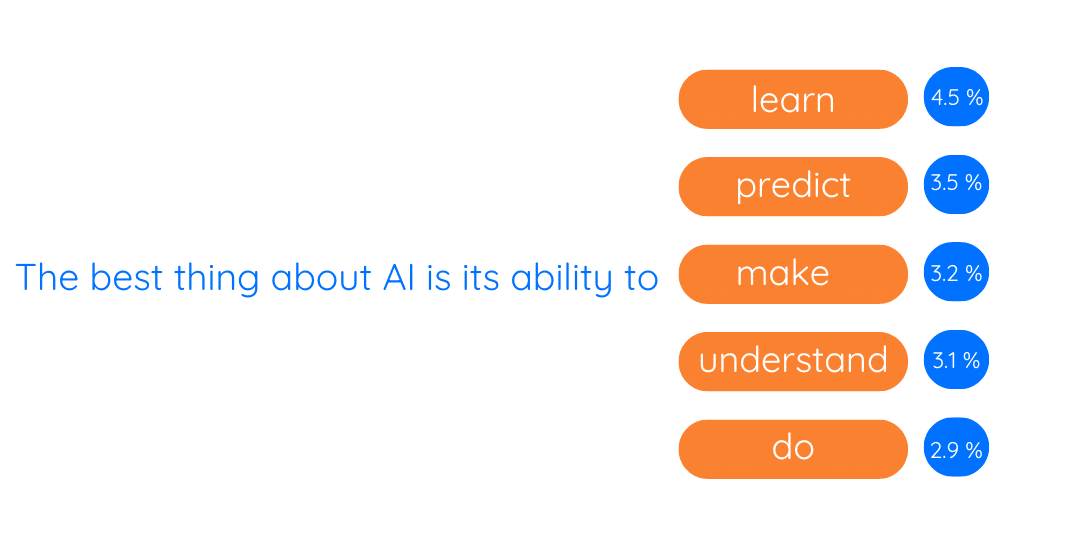
Essentially, an LLM uses its stored information to predict new text. It constructs sentences based on examples, calculating the probability of what the next word will be. Stephen Wolfram illustrates this with a concrete example: after the phrase “The best thing about AI is its ability to,” the word “learn” appears more frequently than “do” in online texts.
Key takeaway
Backlinks with appropriate anchor text remain important, but online mentions are also key. That’s because LLMs look at words that frequently appear next to or near each other. Focus on branding and link mentions of your company name to your expertise or niche. Consider, for example, “Digital Climax SEO agency” in a newspaper article.
OpenAI has been collaborating with Microsoft since 2019. The software giant came on board as an investor, but today both parties refer to it as a partnership. Now that OpenAI is focusing more on profitability, the “bromance” is under strain. Still, it’s reasonable to assume that SearchGPT’s responses will show many similarities to search results in Bing, Microsoft’s search engine.
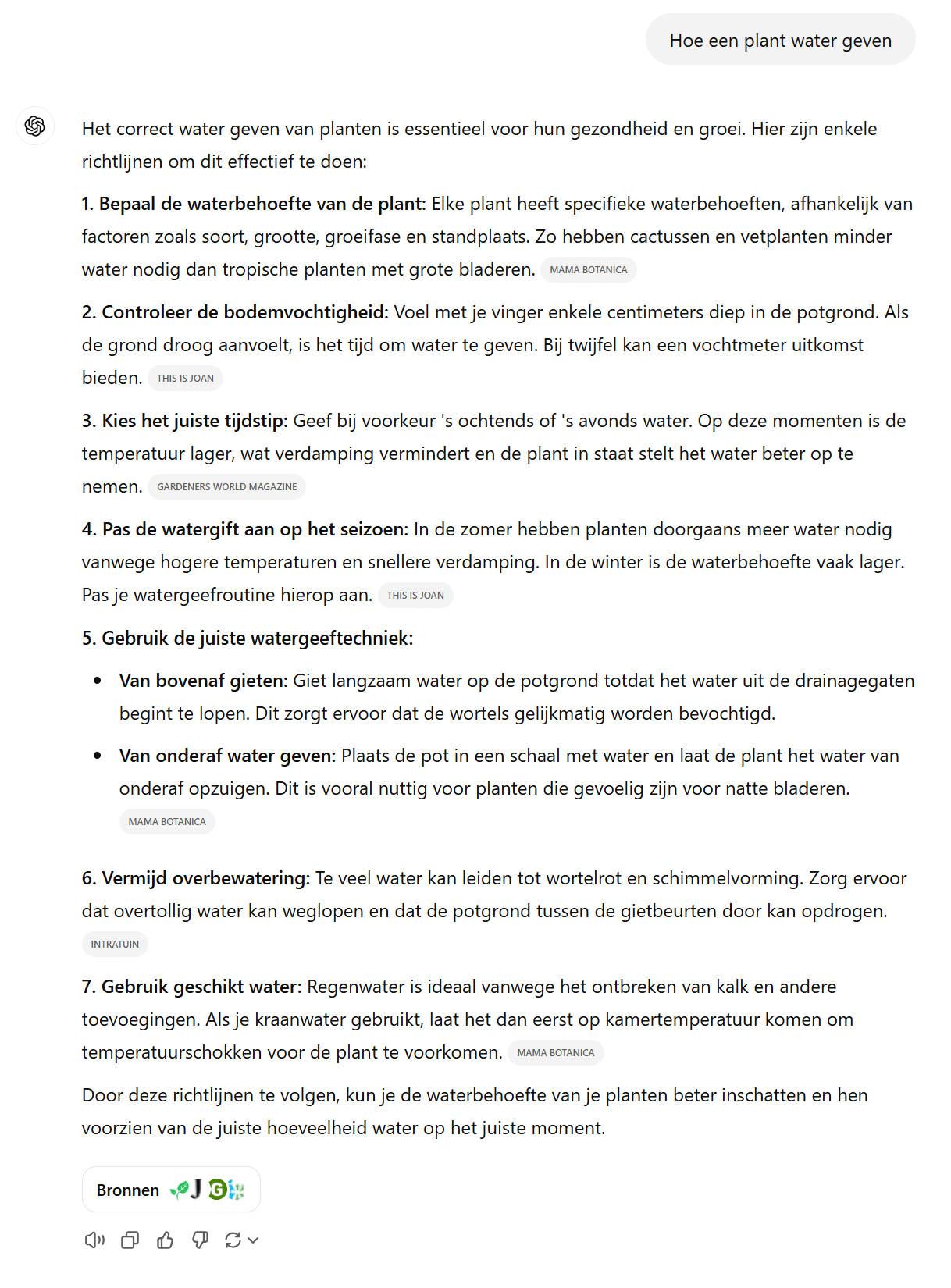
We conducted a limited keyword research using about 30 terms in SearchGPT, Bing, and Google. We ranged from broad search terms like “wall climbing” and “bee hotel” to specific queries such as “how do I water a plant” or “tonight I want to eat game at a restaurant near Lille.” This shows that the connection between SearchGPT and Bing isn’t necessarily stronger or closer than that between SearchGPT and Google.
However, ChatGPT only uses pages that have been indexed by Bing.
Key takeaway
Sign up for Bing Webmaster Tools to track your performance on that search engine. Make sure you don’t block Bing’s crawlers in your robots.txtfile. You technical SEO remains important for ranking. Your on-page content and off-page authority are crucial for ranking higher.
There are no metrics for SearchGPT in online tools, so it’s difficult to track the performance of your pages.
To use ChatGPT as a search engine, click the globe icon in the lower-left corner of the search bar.

Depending on the search intent, you’ll see different layouts; we typically encountered text, images plus text, and a map plus text. SearchGPT doesn’t generate a list of products and links, like traditional search engines do, but instead formulates an answer on its own.

Some search results do include links—especially for businesses with a physical location—or click-through buttons leading to online stores or government websites, for example. When you hover over the button, the favicon, the page title, and the first few lines of text from the link appear. If you click “Sources” at the bottom of the search result, a panel appears on the right with source citations and search results. Users can also click there to go to your website.
Key takeaway
SearchGPT doesn’t exactly encourage users to click through to external websites, but it is possible. We’ve been seeing the same shift toward “zero-click searches” in traditional search engines for some time now, but people have been used to clicking through there for years. Much depends on their search intent (more on that later in this white paper) and how quickly they get the answer to their question.
A common complaint about chatbots is that they regurgitate existing information without citing sources. The information they provide seems brand-new and reliable. But it certainly isn’t brand-new. The same is true of SearchGPT.
Questions are also frequently raised about reliability. Meanwhile, the internet is teeming with examples of chatbots that are starting to hallucinate. For instance, when asked, ChatGPT made up a world record holder for “crossing the North Sea on foot” and scientific articles demonstrating the health risks of cheese.
But AI trains itself, and the number of hallucinations and fabrications seems to be decreasing. SearchGPT does cite sources, which at least makes the search results seem more well-founded. So no more reusing content without giving credit.
Key takeaway
SearchGPT also values the principles of EEAT(experience, expertise, authority, and reliability). Make sure your content shows that you know what you’re talking about. That way, your pages are more likely to rank higher in Google and SearchGPT.
A search engine suggests a number of websites in response to a search query. An LLM uses AI to answer a question based on online content. These are two different approaches, yet they seem to be converging more and more. For example, Google often provides the answer to informational search queries right on its own. Users searching for “capital of Australia” immediately get the answer “Canberra.”

The added value that SearchGPT offers as an LLM that’s evolving into a search engine is the ability to ask follow-up questions. Take, for example, the search query “buy the best laptop.” SearchGPT provides five product recommendations, including photos and brief summaries, plus some practical tips for choosing the right laptop.

If you then reply, “I only want to use email, Word, and Excel,” the LLM understands that the high-end models are no longer relevant and provides a new, more specific list.

Key takeaway
By asking follow-up questions, users unconsciously enter long-tail keywords consisting of multiple words. We were already big fans of this, particularly for Sniper SEO. They remain important, especially with the rise of search bots.
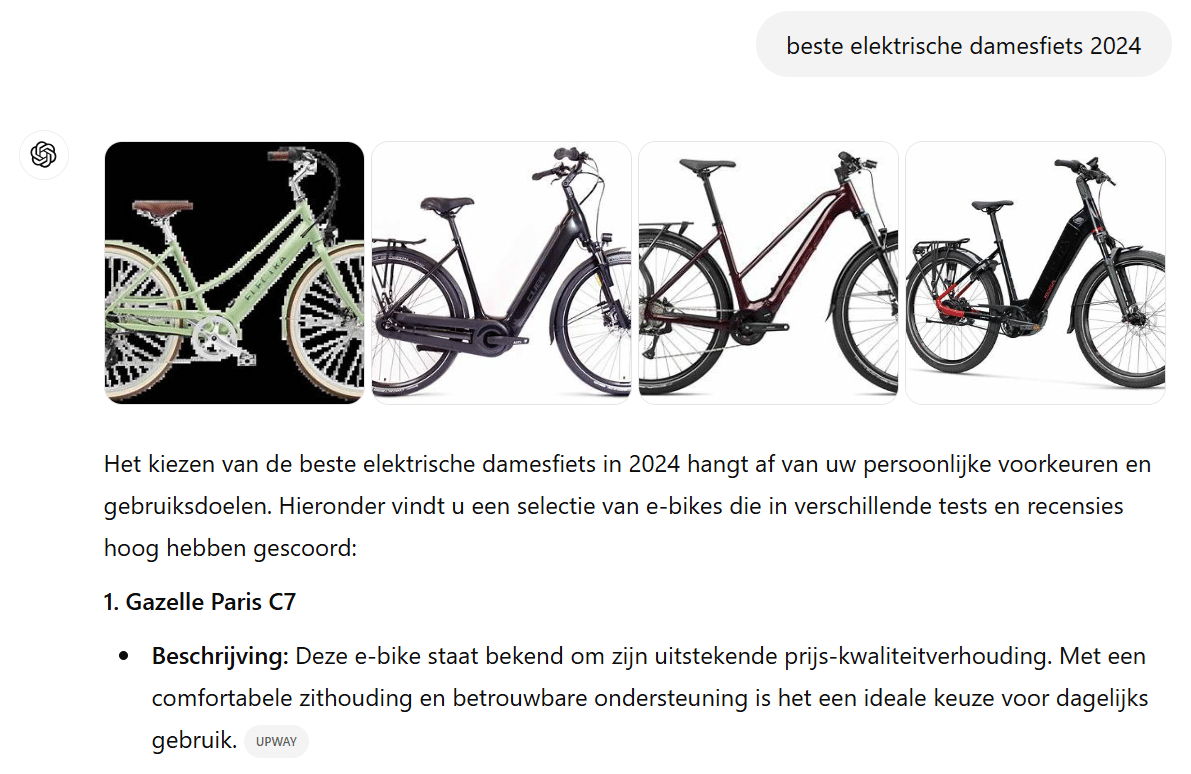
Just like traditional search engines, SearchGPT structures its answers differently depending on the search intent. We put it to the test with a fictional search for a women’s electric bike.
Informative (Attention and Interest in AIDA, Know for Google)
For the search query “women’s electric bike,” SearchGPT provides several images and text blocks, including the key features, popular brands, and buying advice. However, the sources appear to be primarily commercial websites.

Commercial (Desire in AIDA)
For the search query “best women’s electric bike 2024,” the layout of the search results remains the same, but SearchGPT does suggest a few specific models. The sources are primarily informational websites.
Transactional (Action in AIDA, Do for Google)
For the search query “order a women’s electric bike online,” SearchGPT displays a Google Map showing, among other things, the physical locations of Bol.com and Gazelle (not particularly useful) and a few tips for making an informed choice. Both the sources and the search results are commercial.

Navigating (Website for Google)
Koga is a brand of electric bicycles. SearchGPT provides photos and information about the brand and some of its models. Buttons lead to Koga’s website, and blue links lead to retailers in the wider area. Both in the sources and in the search results, Koga’s homepage appears at the top, ready to be clicked.

In-person visit (for Google)
Even after several searches for a women’s electric bike in Lille, we didn’t get a Google Map. Furthermore, SearchGPT directs us to the major cities. However, according to Google, “the e-bike specialist of the Kempen” is located in the borough of Poederlee.

Key takeaway
We expect that informational searches will only generate less traffic in the future. They do, however, help with your brand awareness and authority.
Users do still click through to place an order or make a reservation. So continue to focus on addressing both search queries and search intent.
We’ve already drawn some preliminary conclusions from our mini-survey.
- AI is self-learning. That means that the exact same search query can yield different results each time. We’ve seen this happen in practice a number of times. So it remains important for users to verify their sources.
- The search results in SearchGPT are likely based on the content of websites. One advantage of SearchGPT for users is that the chatbot searches through results in other languages and translates them. For a Dutch-language search query, Google and Bing usually return only Dutch-language results.
- Google and Bing favor websites and pages with higher URL and domain ratings. For lesser-known brands, the chances of ranking well in SearchGPT seem greater.
- Based on our research, we were unable to draw any conclusions about the influence of search results in Google or Bing on those in SearchGPT. Nor are any connections immediately apparent between the websites listed in the source citations and those in the search results. The good news: there’s often overlap between the two. This gives your website a double chance to rank well and attract visitors.
- When SearchGPT displays a map as a response, you can click through to Google Maps (but not to Bing Maps). The location is not very accurate—for example, SearchGPT thought we were in Merksplas, which isn’t even a neighboring municipality of Lille.
As of the publication of this article, SearchGPT has only been online for a few weeks. There are no tools like Google Search Console, Bing Webmaster Tools, or Ahrefs to track your performance and target audience on SearchGPT. And for now, Google continues to hold its own, even after the introduction of ChatGPT and the predicted exodus of users. It makes sense that this exodus never materialized, given that Google pays a hefty sum to be the default search engine on mobile devices. And the majority of traffic today comes from mobile devices.
SearchGPT is a new search engine that offers new opportunities. So it definitely makes sense to optimize for SearchGPT. To do so, the fundamentals of SEO remain important. Make sure your website is technically sound so it can be indexed and you have a chance of being listed. Publish helpful content and work on building your off-page authority.
Be sure to make sure that backlinks provide the necessary context and that strategic keywords appear on the same page. This gives you the best chance of ranking at the top in both traditional and new search engines—and of actually generating results for your business. Being found is nice, but driving conversions is the real goal.

Table of Contents: Optimizing for SearchGPT and Other LLMs
- Optimizing for SearchGPT and Other LLMs
- How a Large Language Model Works
- (No) close connection between SearchGPT and Bing
- How SearchGPT Works
- The Drawbacks of LLMs Compared to Search Engines: Out the Window
- Striking up a conversation with a search engine
- Down the Funnel with SearchGP
- Informative (Attention and Interest in AIDA, Know for Google)
- Commercial (Desire in AIDA)
- Transactional (Action in AIDA, Do for Google)
- Navigating (Website for Google)
- In-person visit (for Google)
- The Results of SearchGPT
- Optimizing for SearchGPT: Our Conclusions