
Nine out of ten people who search for something online still do so via Google today (yes, even in 2026). For years, the search engine held a monopoly. The rise of social media and, more recently, AI and LLMs such as ChatGPT is creating new ways to ask questions online.
If your company wants to be ready for the future, it’s essential to be discoverable in ChatGPT and other LLMs. The basics are the same as “traditional” SEO, but make sure you get the nuances right. Find out how to do that below.
How Traditional Search Engines Work
Google has been the leading online search engine for a quarter of a century now. Exactly how they compile their search results pages is a bigger secret than the Coca-Cola recipe. Thanks to a combination of insights from Google itself and experiments by SEO experts, we now understand many key principles. We apply these principles every day to help our clients rank higher.
For example, to rank highly in search engines, it’s important that you technical SEO is on point. The second key pillar is your content: write helpful content, target one keyword per page based on your keyword research, and connect your pages with internal links to form content clusters. Finally, focus on linkbuilding to acquire backlinks from other websites and thereby increase your online authority.
How Large Language Models Work
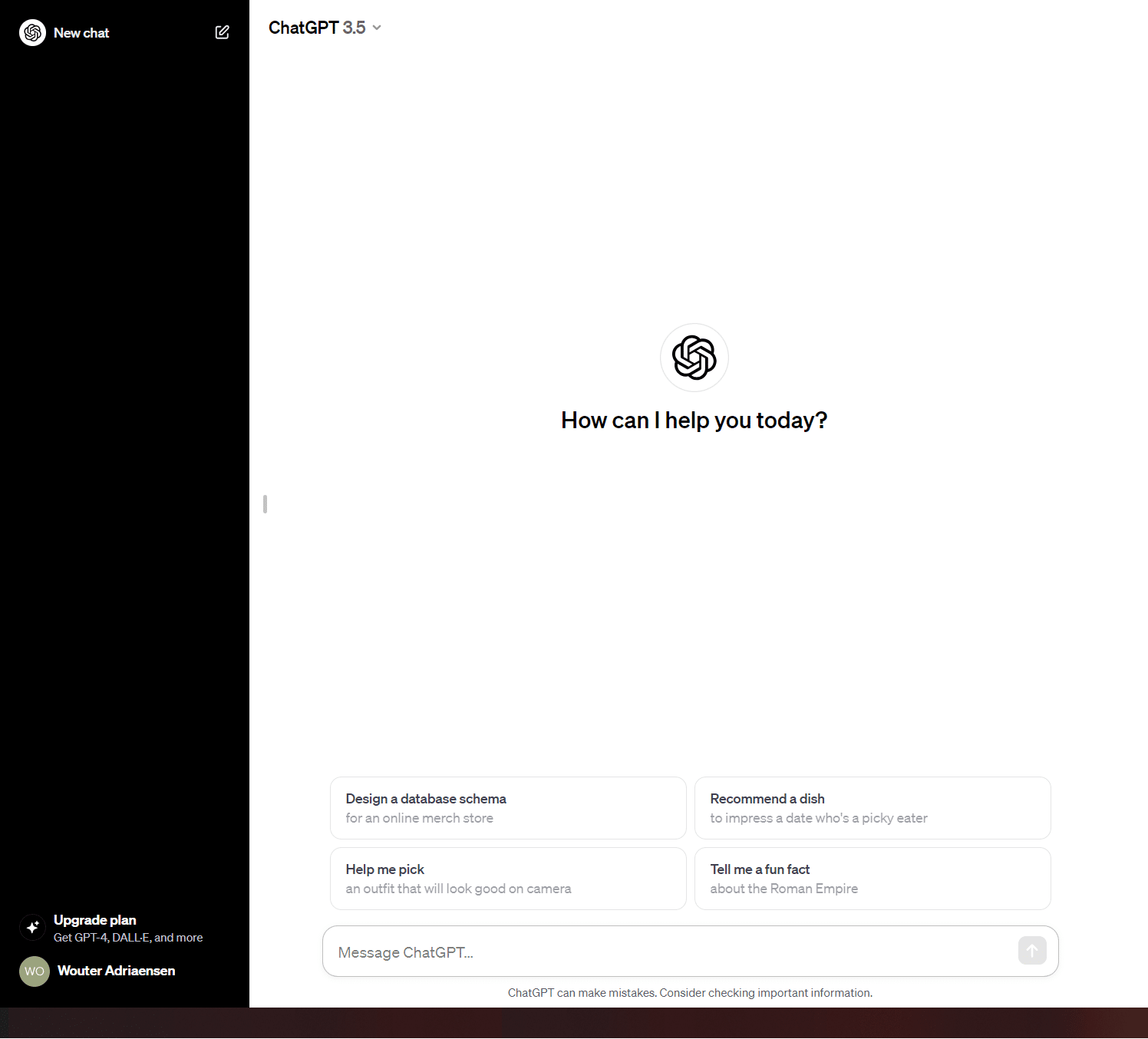
ChatGPT, Perplexity, and Gemini train themselves by analyzing patterns in (primarily) online content. They then use those examples and their knowledge to generate text, images, and videos. By regularly choosing a word other than the most likely next one, they produce a different text each time.
OpenAI introduced ChatGPT in November 2022, followed by Perplexity barely a month later. Since then, Google’s Bard, Anthropic’s Claude, Microsoft’s Copilot, and Google’s Gemini have gone live. More and more people are using them to get answers to their questions. To do so, they set up their ChatGPT with information about their company and who they are. In addition, the LLM draws on the extensive history of past chats. Incorporate that extra context into your content to attract more relevant visitors.
Thanks to a combination of experiments (like the ones we conducted to optimize for SearchGPT) and our understanding of how LLMs work, we now know how to get found in ChatGPT. Of course, just like with SEO, that’s only the first step. You’ll only get clicks from the chatbot at the “bottom of the funnel,” for money keywords that we also target with Sniper SEO (think of your product or service combined with “best,” “cheap,” “buy”…).
Visibility in LLMs such as ChatGPT largely overlaps with that in search engines such as Google. This makes sense: they both have the same goal (to answer their users’ questions as best as possible) and use the same resources (online content) to do so.
So the fundamentals of SEO remain the same. You won’t be found in ChatGPT if your pages take half an hour to load, lack any coherence, or aren’t mentioned anywhere else online. And writing the way you speak, providing clearly structured answers, and selflessly sharing your knowledge? We and our clients have been doing that for years. Still, there are some key differences between ranking in Google versus ChatGPT.
Analyze the AI traffic on your website
Being found in AI-driven search engines is becoming increasingly important. We built a handy tool to check how much traffic you’re getting from search engines and LLMs (ChatGPT, Gemini, Claude, etc.). The tool is perfect for comparing which pages are getting more attention than others.
You can then use that information to respond to trends and identify areas where your website needs optimization.

From Keywords to Phrases
People who search on Google usually enter a search term consisting of one, two, or a few words. Just think of “weather in Antwerp” instead of “What will the weather be like today in Antwerp?”. ChatGPT is a chatbot that users can have conversations with. They ask detailed questions and delve deeper into the answers they receive. That’s why content clusters where you showcase your expertise in depth remain very important.
So, continue to target one keyword per page. Be sure to include all synonyms —not just word-for-word equivalents (such as “heftruck” and “vorklift”), but also longer keywords (such as “forklift license,” “who is allowed to operate a forklift,” “cost of a forklift,” “how much does a forklift cost,” and “difference between a forklift and a reach truck”). You can find these long-tail keywords using SEO tools like Ahrefs, AlsoAsked, and Google Search Console. We’ve been emphasizing their importance for quite some time now, for example, in the context of Sniper SEO.
The Importance of Context
Backlinks—links from other sites to yours—are still important for ranking well in search engines. LLMs “understand” the big picture. A newspaper website that includes a link to our website in an article about Digital Climax as an AIO agency is a nice bonus. But for AI chatbots, simply mentioning “SEO agency Digital Climax” on that website is enough.
Therefore, associate your company name with your most important keyword(s). Use social media and other relevant platforms (industry websites, forums, etc.) to share your content, expand your reach, and raise awareness of your brand. The more “brand mentions” you have outside your website, the better. So be sure to focus on digital PR as well.

Your authority is shifting
After technical factors and content, authority is the third pillar of SEO. Specifically, we’re referring to off-page authority, which usually takes the form of backlinks—over which you have less control than over your on-page technical factors and content. To rank well in ChatGPT, Perplexity, and Claude, your topical authority is at least as important.
So don’t be afraid to highlight and demonstrate your expertise. Make it as specific as possible. And dive as deep as you want or can. Use content clusters (did we mention that ranking well on Google is the foundation for ranking well on ChatGPT?) to share your knowledge in a structured way with your visitors, search engines, and language models.
Don’t hesitate to reach out to us for help. For over 5 years, we’ve done nothing but optimize websites to boost online visibility—first in search engines, and now in AI applications as well. Trust our expertise and drive more traffic, customers, and revenue through your website.