
B2B SEO
The basic principles of B2B SEO are almost exactly the same as B2C SEO. It’s mainly the focus that differs in a professional environment. For instance, search volume for your keywords in B2B SEO is usually lower, but in many cases, it’s easier (or faster) to rank for those keywords.
SEO is SEO. The foundation is working on a website that is as high-performing and user-friendly as possible. That principle remains applicable in a B2B environment as well.

B2C SEO and B2B SEO mainly differ in:
Keyword structure
In most cases—though not always—your future B2B customers search differently than consumers. B2B prospects are often looking for solutions to very specific problems. Finding the keywords that address those problems, combined with the right intent, is an extra challenge.
We are all human, of course. That’s why we prefer to talk about H2H (Human to Human) rather than B2B.
Search volume
Sometimes the search volume for the perfect keyword for your B2B business can be disappointing. Where do you draw the line for minimum search volume? Well, there is no lower limit. As soon as a keyword is interesting and perfectly aligns with what a potential customer might be looking for, we include it. In a B2B environment, tools might even indicate there is no search volume for that keyword. But you know your business and you know which keywords are relevant.
Examples of keywords that “don’t exist” according to tools but have still generated deals:
The website below receives many visitors daily. Yet, no tool shows any search volume for the associated keywords. So don’t stare blindly at the data. Discuss your situation with an SEO specialist and bet on what you think works. Testing is the name of the game!

So don’t get caught up in search volumes, especially with B2B SEO.
Conversion
In a B2B environment, the process from first contact to purchase is much slower. Sometimes it takes months. Now, SEO is by definition a long-term strategy – the ideal match. To build successful B2B SEO, you focus on various touchpoints to stay in the loop of the buying process.
The basic principle of B2B SEO is 99% the same as ‘regular’ SEO. Your technical setup needs to be solid, there must be interesting content (the importance of good SEO copywriting) to read on your website, and with the necessary authority (see linkbuilding), you can rank in Google.
And again: SEO is and remains SEO. Regardless of the application or niche you are optimizing within.
Let’s explain the process for B2B SEO for you:
1) SEO audit
Start at the beginning: where do you stand now? Which keywords are you already ranking for? How is your website structured? Have you already built up authority?
This is how you determine your starting point. In the future, you can look back at this and know exactly what progress you’ve made.
An SEO audit includes the following components:
- Technical website audit
- Competitor analysis
- Backlink analysis to map out your authority.
2) Keyword research
Next up, gathering keywords. During keyword research, we inventory all keywords that could potentially be interesting for your company. Use a minimal filter in this phase, especially with B2B SEO.
3) Developing a B2B SEO strategy
The smaller your filter, the more keywords. Not every keyword is equally interesting. But you only make that choice once you’ve finalized your strategy.
Which keywords are achievable? And which ones aren’t (yet)?
Based on this, you determine your focus and plan of action. Precisely because you have so many keywords, you get a very broad picture. By always keeping the long-term goal in mind, you also know why we implement those things first.
With an eye on the horizon, you make the right decisions.
4) Optimizing the website
Review the technical SEO errors with your web developer. Put them under the microscope and fix them.
Carefully weigh the costs and benefits of a technical adjustment. You don’t always have to implement every change. Sometimes the impact is just too small. To make that call, you need experience and intuition. The number of determining factors is endless.
You can read about the most important technical matters in our SEO guide.
5) Developing content
In 90% of cases, the next step is developing your content: what should be readable on your website? Put everything in the right format, in the right place, and publish high-quality content.
This is where everything comes together for the first time:
- Converting keywords into content
- Determining priorities based on your strategy
- Processing everything into your SEO-proof website
Also getting your content indexed is a challenge.
Our motto: quality always rises to the top. And you can take that literally.
6) Linkbuilding
In the long run, you can’t do without linkbuilding. Compare it to driving a car.
- Your car needs to be technically sound to be able to leave.
- Fuel is required to keep driving. For your website, that’s high-quality content.
- Eventually, you’ll get stuck. Then you need backlinks to keep moving forward.
And of course, you reach your destination faster if your GPS, aka strategy, is set correctly.
Linkbuilding is more of a last resort than a first step.
Just like with SEA, it’s easy to set up a campaign that drives more traffic to your website.
Watch out
With linkbuilding too, you can buy some links to your site and presto, your DR goes up. Great! Spoiler: that doesn’t help you move forward.
You have to go through all the steps, yes even with SEA, to improve your website. Only then will you get better and avoid wasting money on expensive links or SEA campaigns.
At Digital Climax, we only set up SEA campaigns to support an SEO trajectory. That way we’re sure the website is constantly improving. And in the end, everyone reaps the benefits. Both your SEA, social media, and your conversion rate in general.
Tomorrow? Next week? Next year? Or why not today? Every step you take is a gain. You have to start sometime. Ads eventually hit their ceiling.
Your SEO efforts influence multiple elements. That’s why it’s the easiest step to take.
Moreover, in the long run, it’s the cheapest. Look past that mountain of work and keep your goal in mind. Work on your SEO mindset, that’s the message!
Additionally, with SEO you focus on various touchpoints in different phases of the buying process. Initially, your ideal customer is informing themselves; make sure you’re ready with your best information at the top of Google. In your copy, focus on defining the problem and provide your solution.
Yep, your visitor should really be able to get everything they need from your information.
This way you get the full potential out of your SEO efforts and create recognition with your future customers.
As soon as they are actually ready to buy and search for your transactional keywords, they’ll remember your help and find their way to you more easily.
B2B SEO can be used throughout the entire buying process. SEE, THINK, and DO are all suitable for getting in touch with your future customer.
We use SEO as the foundation of our marketing. Okay, maybe a bit of professional bias, but that way we’re sure we’re building something that ensures long-term growth. More traffic and a better website. That combination is wonderfully efficient.
We didn’t just choose that randomly, of course.
Where we first mainly built websites, we were increasingly asked to also bring more traffic to those websites. SEA, SEO, Social Ads… We worked them all out thoroughly. And what turns out? The most efficient is SEO. That’s why we’ve focused entirely on that.
SEO is the perfect foundation, but you also need to ensure short-term results. SEO pays tomorrow’s bills, but you also need to be able to pay today’s.
The more touchpoints you create with your customer, the better. Especially in a relatively long B2B sales process.
Every little bit helps. SEO is the first step because SEO influences all of your company’s marketing activities.
We are firm believers in long-term thinking. That simply brings the best results. What you sow today, you can reap in a year. That’s always our starting point.
LinkedIn is the ideal addition to your B2B SEO activities. More on that shortly.
Long term: SEO
So SEO aims for the long term. You’ve probably realized that by now. It takes an average of 6 – 12 months before you see results from your SEO efforts. Depending on your niche and competition, that might be more or less.
By results, we mean actual revenue. Of course, you’ll see movement sooner. Think of rises in Google, extra traffic, higher conversion rate… Position 70 or 15? That doesn’t make such a big difference. The real wins are in the top 10, top 3, and of course number 1 in Google.
Short term: Social media
To also achieve results in the short term, social media is a powerful tool. In a B2B environment, we think of LinkedIn first. We’ve certainly seen positive results from it.
The advantage? You can transform all your SEO content and share it via LinkedIn. Killing two birds with one stone.
Depending on your ideal customer, other social media platforms might also be interesting. Make that assessment before you start.
Or even better: test! Test what works, learn, and optimize. And above all, don’t give up. Because that’s where it often goes wrong in B2B marketing: giving up too soon.
Remember: SEO is long-term.
Yes, that’s the strategy we constantly apply ourselves. LinkedIn and SEO go hand in hand and bring fantastic results.
Both focus on the long term and therefore require a good vision and a healthy dose of perseverance. That’s why we emphasize a strategy and plan of action so much. That way you always have something to fall back on.
No, you won’t see results from your SEO work overnight. But you will see them, even with SEO for small businesses.
You can, however, estimate where you currently stand based on your SEO audit and keyword research and determine where you want to grow.
Most companies get stuck when working out the steps to actually grow.
Tip: also set interim goals, so you can see the progress. Otherwise, it might feel like you’re running in place. Especially in the beginning. Don’t get demotivated and keep going.
Feel free to give us a shout if you’re looking for some extra motivation.
Don’t stare blindly at rankings and traffic. Look further and measure the extra leads, compare your revenue, and check if your target audience remembers you better.
Very often there’s a black hole between your SEO efforts, any LinkedIn content, and the actual results.
No, you can’t measure everything. Tracing every lead back to the actual keyword, blog post, or LinkedIn post is a mission impossible.
My competitor can also get to work with this info
True. Every post or content page you put online can be copied by someone else. But you position yourself as an expert by sharing your knowledge. So what if competitors run off with your idea? They can never do all the elements exactly the same way.
There are enough unique factors to your company to distinguish yourself. If not, you know what to figure out!
This way my customer can solve the problem themselves
With this guide, combined with all the content on our site, you can perfectly get started with your B2B SEO yourself. Are you actually going to do it?
We encourage that. The more people involved in SEO, the better!
Still, we notice that many entrepreneurs prefer to focus on their core business and choose our expertise and experience to support them in their SEO story.
It’s probably the same with your customers, right?
Tough question. We usually counter it with “How far and how fast do you want to go?”. You can get from A to B in an old car. But you’ll get there a lot faster in a Formula 1 car.
Calculating exactly how much it will cost you to get to position 1 in Google is impossible. Just ‘fixing’ your SEO is a pipe dream. Make sure you start, that you test new things, and constantly adjust.
That’s the only way you can grow and get better.
Other questions you can ask to get a view on B2B SEO budgets:
- How many blogs do you want to publish per month?
- Are your blogs high-quality and SEO-proof?
- Which copywriter are you working with?
- How many backlinks do you want and how relevant should they be?
- Do you already have a website and is it SEO-proof? Or do you need a new website?
- What is your starting point? Do you already have traffic?
- Have you ever worked on SEO before? Or do you still need to figure out all the processes?
- Do you have the necessary knowledge and experience in-house or are you hiring an external partner?
To measure the Return On Investment (ROI) of B2B SEO, there’s a simple formula. Although here too, there are a number of black holes that are difficult to include in your calculation.
(SEO website visitors * Conversion rate) * Average order value = SEO revenue
Choose an SEO agency with experience. As we already mentioned, B2C SEO and B2B SEO are essentially the same. The nuances are different, mainly in your keywords and the development of the strategy.
Certainly, you can perfectly do B2B SEO yourself. How fast that goes depends on your SEO experience, time, and interest.
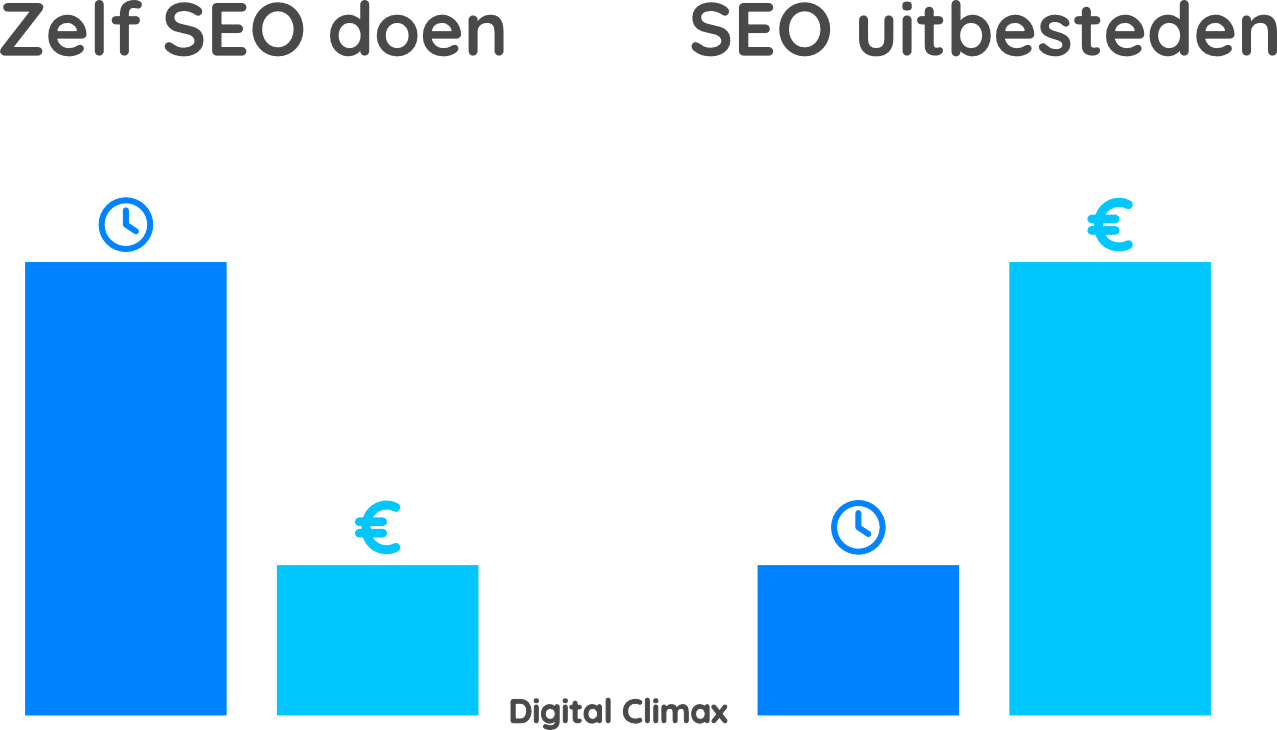
B2B SEO always requires an investment. Doing it yourself? Then you invest time. Choosing to outsource? Then you invest budget.
With a few classic SEO tools, you’ll get a long way. There are no specific SEO tools for B2B.
If you choose to outsource your SEO, you significantly reduce your own time investment. You don’t have to learn SEO yourself, you don’t have to work everything out yourself, and you avoid common mistakes (Yes, we’ve already made those for you).
We always strive to keep our clients’ time investment to a minimum. Of course, we don’t work in a vacuum, and we need input from you (read: business knowledge).
Standardly, we review the work performed, progress, and any issues on a monthly basis.
Table of Contents
- What is B2B SEO?
- What is the difference between B2B and B2C SEO?
- How does B2B SEO work?
- How do you start with SEO for B2B?
- SEA for B2B companies
- When to start with B2B SEO?
- Why invest in SEO in a B2B environment?
- Where does SEO fit into your B2B marketing strategy?
- Why you shouldn’t only focus on SEO in a B2B market?
- Short & long-term strategy for B2B companies
- LinkedIn & SEO: a top combo for B2B companies
- Setting realistic goals for your B2B SEO efforts
- Thoughts that hold back your B2B SEO growth
- How much does B2B SEO cost?
- What is the ROI of B2B SEO?
- Who do you hire for your B2B SEO?
- Can I get started with B2B SEO myself?
- What tools do you need for B2B SEO?
- How much time does B2B SEO require from you?